

Carried by 3 nurseries
View Availability at NurseryData provided by the participants of the Consortium of California Herbaria
View additional distribution information on the Jepson eflora
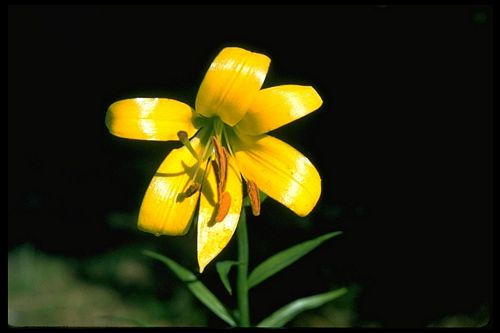
Lilium parryi is a rare species of lily known by the common names lemon lily and Parry's lily. It is native to the southwestern United States and northern Mexico where it is a rare sighting in moist areas in mountain habitat. In California it is currently known from the San Bernardino and San Gabriel Mountains and a few remaining spots near Palomar Mountain to the south. It is the only true lily native to Arizona, where a few populations can be found in the Huachuca, Chiricahua, and Santa Rita Mountains. An occurrence of the plant was discovered in Sonora just south of the United States border in 1993. This is a perennial herb growing erect to about 2 meters in height from a scaly, elongated bulb up to 11 centimeters long. The leaves are generally linear in shape, up to 29 centimeters long, and usually arranged in whorls around the stem. The flower cluster is a raceme bearing up to 31 large, showy, bright lemon yellow flowers. The trumpet-shaped, fragrant flowers have six curling petals up to 11 centimeters long, sometimes with a few reddish spots. There are six stamens tipped with large anthers up to 1.4 centimeters long. The pistil may be 10 centimeters long. The flowers are pollinated by hawkmoths, especially Hyles lineata and Sphinx perelegans.
Perennial herb, Geophyte
4 - 8 ft Tall

Yellow, Red
Summer, Fall
Full Sun, Partial Shade
Moderate
Fast, Medium, Slow
Tolerant of a variety of garden soils as long as sufficient moisture is available.
For propagating by seed: Sow outdoors in summer for germination the following spring, or 3-6 mos. warm then 2-3 mos. cold stratification. For forcing slightly green or fresh seeds: 6-8 wks. warm (70°F) stratification or until the majority of seeds have formed bulblets; then 4-6 wks. cold (about 35°FJ stratification; sow, and at 55 to 60°F leaves should be produced in 4-6 wks. (De Graaff 1951).
Meadows and stream edges
Red Fir Forest, Yellow Pine Forest, Wetland-Riparian
Butterflies and moths supported
0 confirmed and 1 likely
Reaper Dart
Euxoa messoria