

Carried by 0 nurseries
View Availability at NurseryData provided by the participants of the Consortium of California Herbaria
View additional distribution information on the Jepson eflora
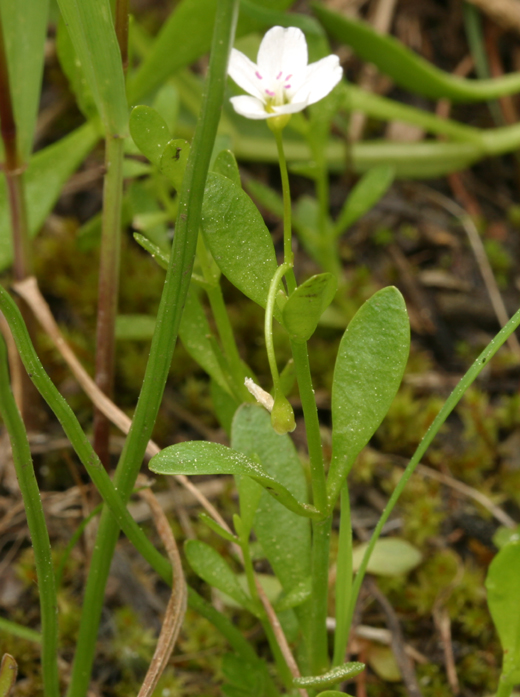
Montia chamissoi is a species of flowering plant in the purslane family known by the common names of water minerslettuce, water montia, Indian lettuce, and toad lily. It is native to much of western North America from Alaska to the southwestern and central United States and also in British Columbia. It grows in moist to wet soils in a variety of habitat types, such as meadows, wetlands, plains, and montanes (Kershaw et al., 1998). It is sometimes aquatic, anchoring in mud and floating in water. M. chamissoi appears between 7,000 to 9,000 feet in elevation (Brussard, 1982). and are endemic to western North America. Wetlands, montanes, and prairie zones are where M. chamissoi thrive. They occur in the Rocky Mountain region, Pacific Alaska Region, Pacific Region, and even in part of the mid-atlantic and great lakes region. They are also highly prevalent in Canada including Alberta and British Columbia. It can also grow on the dry slopes of the plains and foothills creating a huge distribution. It is found along coastal areas but this is mostly rare (Brussard, 1982). Related Species. Related taxa involves 10 genera in Portulacaceae and 9 species in Montia. A few genera related are spring beauty ( Claytonia L. ), fame flower (Talinum adans. ), and red maids (Calandria kunth). Like M. chamissoi these genera have very large distributions and stamens. Montia fontana and Motia parvifolia are two relating species that involve wide distributions but differ in the fact that the distributions are higher in elevation and take up most of Canada and Greenland.
Brussard noted that there have been failures and success when trying to preserve M. chamissoi due to mining development that has lowered small M. chamissoi populations in the United States (Brussard, 1982). Brussard (1982) observed that a population of M. chamissoi was destroyed by road construction near a ski area and it was also noted that this was the only known population in Gunnison County, Colorado. This led to an increase in Rocky Mountain Biological Laboratories and helped establish the laboratory' claim to undisturbed habitat as a natural resource (Brussard, 1982). It is also a rare plant species in British Columbia and is a candidate species for restoration and preservation. (Rose & Burton, 2011). Even though, M. chamissoi has a very wide distribution it is currently listed on the endangered list in Minnesota and Pennsylvania and is in the progress of restoration
Perennial herb

Red
Alpine Fell-Fields, Lodgepole Forest, Red Fir Forest, Subalpine Forest, Wetland-Riparian, Yellow Pine Forest