

Carried by 2 nurseries
View Availability at NurseryData provided by the participants of the Consortium of California Herbaria
View additional distribution information on the Jepson eflora
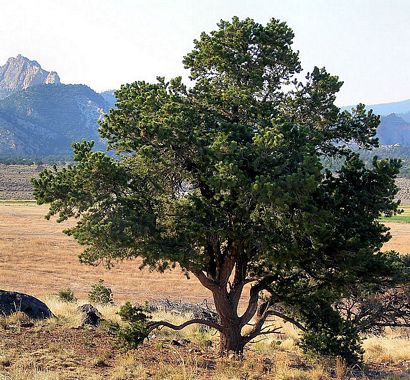
The Colorado Pinyon, Two-needle Pinyon or Pion Pine (Pinus edulis) is a pine in the pinyon pine group whose ancestor was a member of the Madro-Tertiary Flora (a group of drought resistant trees) and is native to the United States. The range is in Colorado, southern Wyoming, eastern and central Utah, northern Arizona, New Mexico, and the Guadalupe Mountains in westernmost Texas. It occurs at moderate altitudes from 1600-2400 meter, rarely as low as 1400 meter and as high as 3000 meter. It is widespread and often abundant in this region, forming extensive open woodlands, usually mixed with junipers. The Colorado pinyon (pion) grows as the dominant species on 4.8 million acres (19,000 km) in Colorado, making up 22% of the state's forests. The Colorado pinyon has cultural meaning to agriculture, as strong pion wood "plow heads" were used to break soil for crop planting at the state's earliest known agricultural settlements. There is one known example of a Colorado Pinyon growing amongst Engelmann spruce (Picea engelmannii) and limber pine (Pinus flexilis) at nearly 3,170 meters (10,400 feet) on Kendrick Peak in the Kaibab National Forest of northern Arizona.
Tree
25 - 50 ft Tall
Pyramidal
Slow

Yellow
Summer
Containers
Full Sun, Partial Shade
Low, Very Low
Moderate
Fast
Found in a variety of soils but often rocky or coarse, fast draining soil.
For propagating by seed: Fresh seeds need no treatment; stored seeds 2 mos. stratification; or soak in cold ( 40°F) water for 24 hrs. (USDA Forest Service 1974); or keep maximum germinating temperature below 73°F (Heit 1968a).
Pinyon-Juniper Woodland
Butterflies and moths supported
0 confirmed and 13 likely
Red Girdle Moth
Caripeta aequaliaria
Pandora Pinemoth
Coloradia pandora
Variable Girdle Moth
Enypia venata