

Carried by 7 nurseries
View Availability at NurseryData provided by the participants of the Consortium of California Herbaria
View additional distribution information on the Jepson eflora
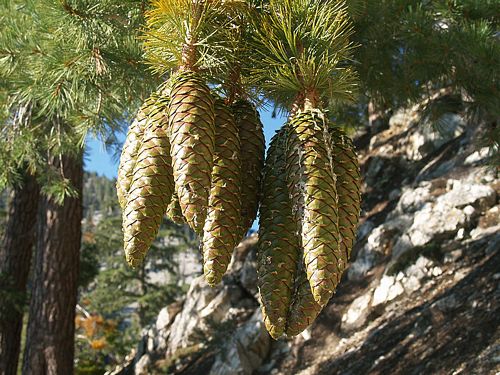
Pinus lambertiana (commonly known as the sugar pine or sugar cone pine) is the tallest and most massive pine tree, and has the longest cones of any conifer. It is native to the mountains of the Pacific coast of North America, from Oregon through California to Baja California. The sugar pine occurs in the mountains of Oregon and California in the western United States, and Baja California in northwestern Mexico; specifically the Cascade Range, Sierra Nevada, Coast Ranges, and Sierra San Pedro Martir. The sugar pine is the largest species of pine, commonly growing to 40-60 meters (130-200 ft) tall, exceptionally up to 82 m (269 ft) tall, with a trunk diameter of 1. 5-2. 5 m (4. 9-8. 2 ft), exceptionally 3. 5 m (11 ft). Pinus lambertiana is a member of the white pine group, Pinus subgenus Strobus, and like all members of that group, the leaves ('needles') are in bundles (fascicles) of five, with a deciduous sheath. They are 6-11 cm (2. 4-4. 3 in)ch) long. Sugar pine is notable for having the longest cones of any conifer, mostly 25-50 cm (9. 8-19. 7 in) long, exceptionally up to 66 cm (26 in) long (although the cones of the Coulter pine are more massive). The seeds are 10-12 mm (0. 39-0. 47 in) long, with a 2-3 cm (0. 79-1. 18 in) long wing that aids wind dispersal. The seeds of the sugar pine are also a type of pine nut and are edible.
Tree
40 - 230 ft Tall
Upright
Fast
Winter Deciduous

Brown
Spring
Bank stabilization
Full Sun, Partial Shade
Low
Moderate
Fast, Medium, Slow
Prefers sandy or loamy soils. Does not grow well in clay soils.
Prune in winter when wood boring insects are less active.
For propagating by seed: 2-3 mos. stratification (USDA Forest Service 1974).
1, 2, 3, 4*, 5*, 6*, 7, 15*, 16, 17
Forests
Red Fir Forest, Yellow Pine Forest
Butterflies and moths supported
2 confirmed and 90 likely
Sugar Pine Tortrix Moth
Choristoneura lambertiana
Sequoia Pitch Moth
Synanthedon sequoiae
Common Gray
Anavitrinella pampinaria