

Carried by 0 nurseries
View Availability at NurseryData provided by the participants of the Consortium of California Herbaria
View additional distribution information on the Jepson eflora
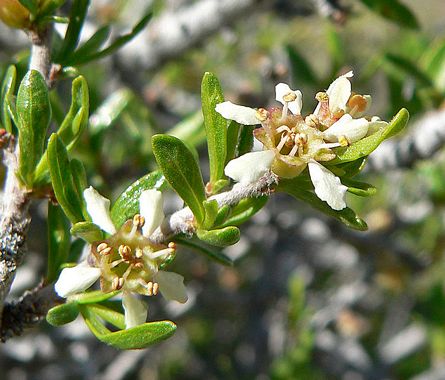
Prunus fasciculata (syn. Emplectocladus fasciculata (Torr.); Desert almond) is a perennial deciduous shrub native to the deserts of Arizona, California, Nevada and Utah. It prefers sandy or rocky soil on dry slopes and washes up to 2200 meter. of altitude. It grows up to two meters high, exceptionally larger, with divaricately branching, spinescent, lightly thorned branches, often in thickets. The bark is grey and smooth. The leaves are 5-10 millimeter long, spatulate, oblance-shaped, linear, arranged on very short petioles in fascicles, or bundles. The flowers are small and white with 3 millimeter; petals, occurring either solitary or in fascicles and are subsessile growing from the leaf axils. They are dioecious. Male flowers have 10-15 stamens; female, one or more pistils. The plant displays numerous fragrant flowers from March to May, which attract the bees that pollinate it. The drupe is about 1 centimeter long, ovoid, light brown and hairy with thin flesh.
Tree, Shrub
4 - 7 ft Tall
Upright
Slow
Winter Deciduous

White, Cream
Spring, Winter
Bank stabilization, Hedge
Full Sun, Partial Shade
Very Low
Fast
Prefers sandy or loamy soils. Does not grow well in clay soils.
For propagating by seed: No treatment. For propagating by seed: Soak 2-3 days in water at room temperature. Changing water 1-2 times per day is beneficial.
Slopes, canyons, washes,
Chaparral, Coastal Sage Scrub, Creosote Bush Scrub, Joshua Tree Woodland, Pinyon-Juniper Woodland
Butterflies and moths supported
3 confirmed and 122 likely
Western Tent Caterpillar
Malacosoma californica
Climbing Cutworm
Abagrotis orbis