

Carried by 11 nurseries
View Availability at NurseryData provided by the participants of the Consortium of California Herbaria
View additional distribution information on the Jepson eflora
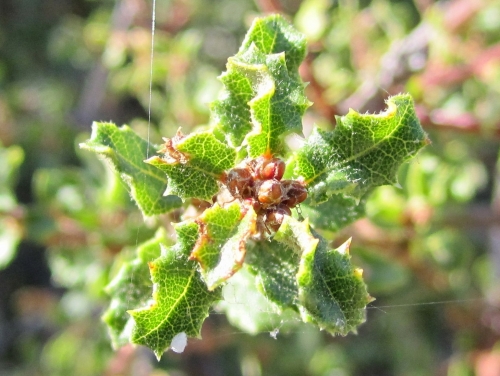
Quercus dumosa is a species of plant in the Fagaceae family. This shrub/small tree goes by the common name Coastal sage scrub oak. It is found in Mexico and the United States. It is threatened by habitat loss. The species Quercus dumosa lends its name to the eponymous plant community Quercus dumosa chaparral, in which Coastal sage scrub oak and toyon often co-dominate. It is easily confused with other scrub oaks such as Quercus berberidifolia, with which it may hybridize.
This plant is an evergreen shrub growing 1 to 3 meters tall from a large, deep root network. The leaves have spiny or toothed edges. The fruit is an acorn up to 1.5 centimeters wide. Some individuals produce large crops of acorns, and some produce very few fruits. The acorns are dispersed by gravity as they fall from the tree, and by animals that pick them up, such as squirrels and jays. Animals eat them immediately or cache them for later. The acorns tend to germinate easily. Reproduction via seed generally occurs only in very moist years.
This oak grows primarily in sandy soils such as sandstone near the coast. Its habitat is often chaparral. This oak sprouts vigorously from its stump and root crown after wildfire and develops a large canopy within a few years after a fire event. It sometimes codominates with Ceanothus species as early as four years after a fire. This oak also does well in the absence of fire.
Tree, Shrub
3 - 10 ft Tall
8 - 10 ft Wide
Upright, Mounding, Spreading
Very Slow, Slow
Evergreen
None

Yellow, Cream, Green
Spring, Winter
Bank stabilization, Hedge
Full Sun
Low, Very Low
Max 1x / month once established
Moderate
Tolerates cold to -5° F
Fast, Medium
Often but not always found on eroded gabbro or sandstone soils.
Soil PH: 6.0 - 8.0
Can be propagated from acorns. For propagating by seed: Fresh seeds sow in fall outdoors or stratify to hold for spring sowing. If started indoors or in glasshouse, stratify first for 1-3 mos. (USDA Forest Service 1974).
Flats, canyon bottoms, bottoms of slopes, mesas
Chaparral
Toyon,Del Mar Manzanita, Summer Holly (Comarostaphylis diversifolia ssp. planifolia), Tree Poppy
Butterflies and moths supported
16 confirmed and 150 likely
Sallow Button
Acleris hastiana
Orange Tortrix Moth
Argyrotaenia franciscana
Andromache Underwing Moth
Catocala andromache