

Carried by 31 nurseries
View Availability at NurseryData provided by the participants of the Consortium of California Herbaria
View additional distribution information on the Jepson eflora
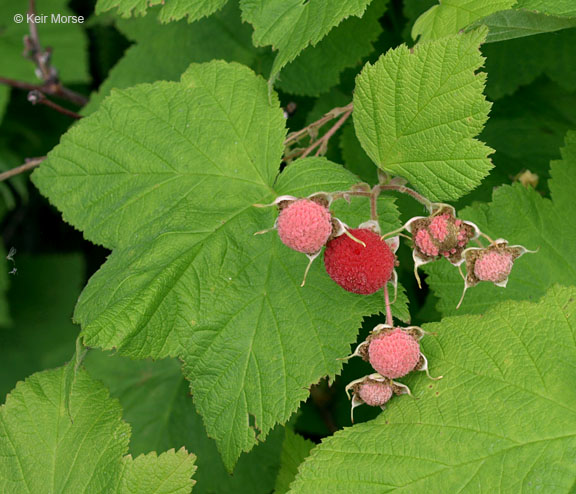
Thimbleberry (Rubus parviflorus) is a perennial in the Rose family and is related to raspberries and blackberries. Spreading through underground rhizomes, the thornless canes can create a dense stand that is topped by large, maple-like leaves. In the spring, large white flowers bloom above the leaves. A bright red, edible fruit that resembles a raspberry (or a thimble, as the name suggests), ripens in summer.
Bees and other pollinators are attracted to the flowers, and the leaves are a host plant for many different species of butterflies and moths. Birds and other mammals eat the berries.
Thimbleberries grow in partly-shaded forest openings and on moist woodland canyons or slopes. Use Thimbleberry for erosion control on slopes in a forested garden; near shady creeks or streams; or on the north side of a house. Thimbleberry can be used as a native plant substitute for non-native berries in an edible garden or food forest.
Shrub, Perennial herb
4 - 8 ft Tall
Upright, Spreading
Moderate, Fast
Winter Deciduous
Pleasant

White, Yellow
Spring
Containers, Hedge
Partial Shade
Low, Moderate
Max 1x / month once established
Easy
Tolerates cold to -10° F
Fast
Prefers moist, fertile soil with good drainage.
Soil PH: 5.0 - 7.0
For propagating by seed: 3 mos. stratification may give satisfactory germination. Soaking in either 1% sodium hypochlorite (household bleach) 7 days or concentrated H2S04 20-60 mins., then 3 mos. warm and 3 mos. cold stratification may improve germination (USDA Forest Service 1974). Easily propagated from stem cuttings.
1, 2, 4*, 5*, 6*, 7*, 14, 15*, 16*, 17*, 18
Shaded, moist areas on the edge of woodland or forest, often in mountains
Closed-cone Pine Forest, Mixed Evergreen Forest, Red Fir Forest, Forest, Yellow Pine Forest, Wetland-Riparian
Use with trees from its native range, such as Fir (Abies spp.), Pine (Pinus spp.), and Redwood (Sequoia sempervirens)
Butterflies and moths supported
2 confirmed and 70 likely
Brittania Moth
Acleris britannia
Yellow-Banded Day Sphinx
Proserpinus flavofasciata