

Carried by 4 nurseries
View Availability at NurseryData provided by the participants of the Consortium of California Herbaria
View additional distribution information on the Jepson eflora
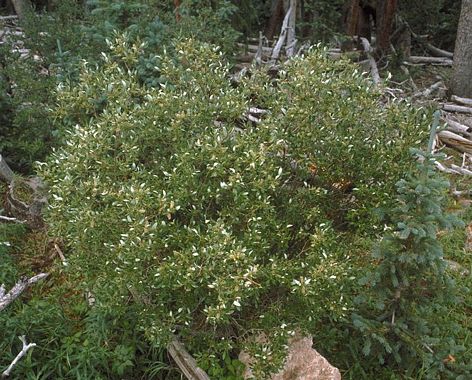
Salix scouleriana, or Scouler's Willow, is a species of willow native to western North America. Other names occasionally used include fire willow, Nuttall willow, mountain willow, and black willow. It is a deciduous shrub or small tree, depending on the environment, usually with multiple stems that reach 2 to 7 meter in height in dry, cold, high elevation, and other difficult environments, and 10 to 20 meter in favorable sites. The stems are straight and support few branches generally resulting in narrow crowns. The root system is fibrous, deep, and widespread. The thick sapwood is nearly white, and heartwood is light brown tinged with red. Stem bark is thin, gray or dark brown with broad, flat ridges. Twigs are stout and whitish green. The leaves are oblance-shaped to elliptic, 5-12.5 centimeter long, mostly short-pointed at the tip and tapered toward the base with entire to sparsely wavy-toothed margins. They are dark-green and nearly hairless above, and white- or grayish-hairy below. It is dioecious, having male and female flowers on different trees. The flowers are tiny, grouped in pussy willow-like catkins. The anthers, two per flower, are yellow, sometimes tipped with red; pistols are red. The fruit is light reddish-brown, long-pointed capsules about 0.75 centimeter long. At maturity, they open to release a white fluff with tiny imbedded seeds.
Tree, Shrub
7 - 50 ft Tall
Upright
Fast
Winter Deciduous

Yellow, Cream, White
Spring, Winter
Full Sun, Partial Shade
High
Adaptable, tolerant of sand, loam and clay.
For propagating by seed: No treatment. Use fresh seeds (usually only viable a few days). Seeds should not be covered or pressed into a medium. Seedbed should be kept saturated for the first month. Easily propogated from cuttings.
1*, 2*, 3*, 4, 5, 6, 7*, 8, 9, 10, 14, 15*, 16*, 17*, 18*, 19, 20, 21, 22, 23, 24
Meadows
Chaparral, Foothill Woodland, Lodgepole Forest, Red Fir Forest, Subalpine Forest, Valley Grassland, Yellow Pine Forest, Wetland-Riparian
Butterflies and moths supported
3 confirmed and 213 likely
Luteus Dart Moth
Abagrotis trigona
Western Tiger Swallowtail
Papilio rutulus
Willow Leaf Blotch Miner
Phyllonorycter salicifoliella