

Carried by 0 nurseries
View Availability at NurseryData provided by the participants of the Consortium of California Herbaria
View additional distribution information on the Jepson eflora
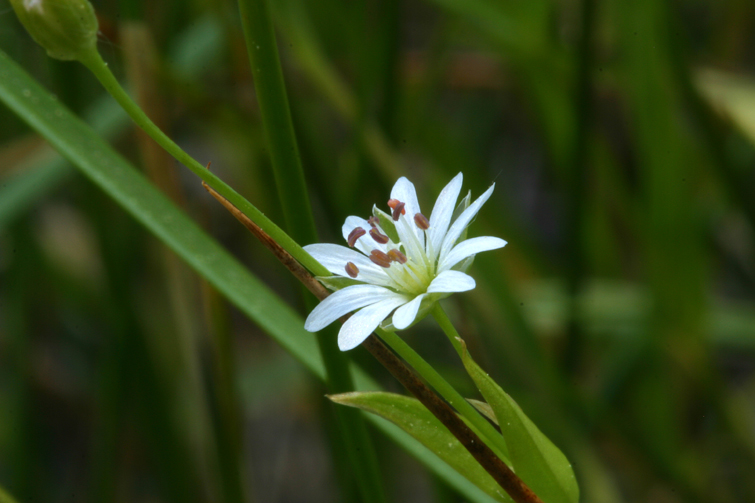
Stellaria longipes is a species of flowering plant in the pink family known by the common name longstalk starwort. It has a circumpolar distribution, occurring throughout the northernmost latitudes of the Northern Hemisphere. It grows in a wide variety of habitat types, including tundra and taiga and many areas farther south with subalpine and alpine climates. It is extremely variable in morphology, its form depending on both genetic makeup and environmental conditions. It has a widely varying number of chromosomes. In general, it is a rhizomatous perennial herb forming mats or clumps, or growing erect. The stems may be short and simple or with sprawling and highly branched. The linear to lance-shaped leaves are usually 1 to 4 centimeters long and are oppositely arranged in pairs. The inflorescence bears one or more flowers, each on a short pedicel. The flower has five pointed green sepals each a few millimeters long. There are five white petals each divided into two lobes, sometimes shallowly, but often so deeply there appear to be two petals. The plant is gynodioecious, with some flowers having functional male and female reproductive parts and others being only female. There are two subtaxa. The rarer of the two, ssp. arenicola, is limited to the sand dunes adjacent to Lake Athabasca in central Canada.
Perennial herb
11 in Tall
Upright
Moderate

White, Green
Spring
Adaptable, tolerant of sand, loam and clay.
Lodgepole Forest, Red Fir Forest, Subalpine Forest, Wetland-Riparian, Yellow Pine Forest
Butterflies and moths supported
0 confirmed and 14 likely