

Carried by 55 nurseries
View Availability at NurseryData provided by the participants of the Consortium of California Herbaria
View additional distribution information on the Jepson eflora
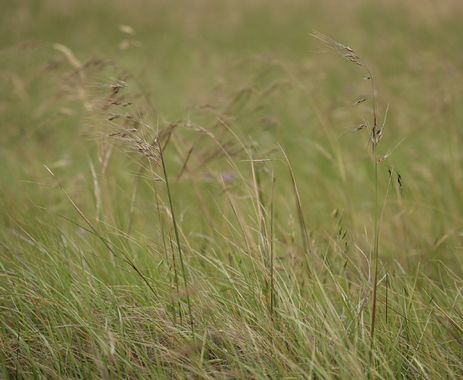
Purple Needlegrasss is California's most widespread native grass. It was named California's State Grass in 2004.
Purple needlegrass gets its name from the color of its young seeds. It is a perennial bunchgrass that can grow up to 3 feet tall. It has a deep root system, which makes it drought adapted and a good plant choice for erosion control.
Purple needlegrass is easy to grow and tolerant of most soil types, including poor and disturbed soils. Plant in full or part sun as part of a low-water meadow garden. This grass produces a large amount of seeds, which attract birds and other wildlife. It has long awns, and pet owners should be aware that they are prickly. It can be cut back when it turns brown at the end of summer.
Grass
3 ft Tall
2 ft Wide
Fountain
Moderate, Slow
Evergreen
None

Red, Green, Purple, Cream
Spring
Deer resistant, Groundcover, Lawn alternative
Full Sun
Very Low
Max 1x / month once established
Easy
Tolerates cold to 5° F
Medium
Found in virtually every type of soil.
Tolerates serpentine soil.,Tolerates sodic soil..
Soil PH: 6.0 - 8.0
Tends to self-sow under favorable conditions. For propagating by seed: No treatment.
Found in many settings, including valley grasslands, openings in chaparral and coastal sage scrub, understory of oak woodlands, on coastal prairie as well as coastal bluffs, terraces, mesas, inland canyons, valleys, foothills, dry meadows, and elsewhere.
Chaparral, Coastal Sage Scrub, Foothill Woodland, Valley Grassland
Potential companion plants include nearly every native shrub. To maintain a true grassland look (with few or no shrubs), use geophytes such as Wild Onions (Allium spp.), Brodiaea species, Mariposa Lilies (Calochortus spp.) and Dichelostemma species, along with annual wildflowers from seed.
Butterflies and moths supported
0 confirmed and 4 likely
Common Ringlet
Coenonympha tullia
Juba Skipper
Hesperia juba
Nevada Skipper
Hesperia nevada
Uncas Skipper
Hesperia uncas
Bornstein, C., Fross, D., O'Brien, B. (2011). Reimagining the California Lawn: Water-conserving Plants, Practices, and Designs. Cachuma Press.