

Carried by 30 nurseries
View Availability at NurseryData provided by the participants of the Consortium of California Herbaria
View additional distribution information on the Jepson eflora
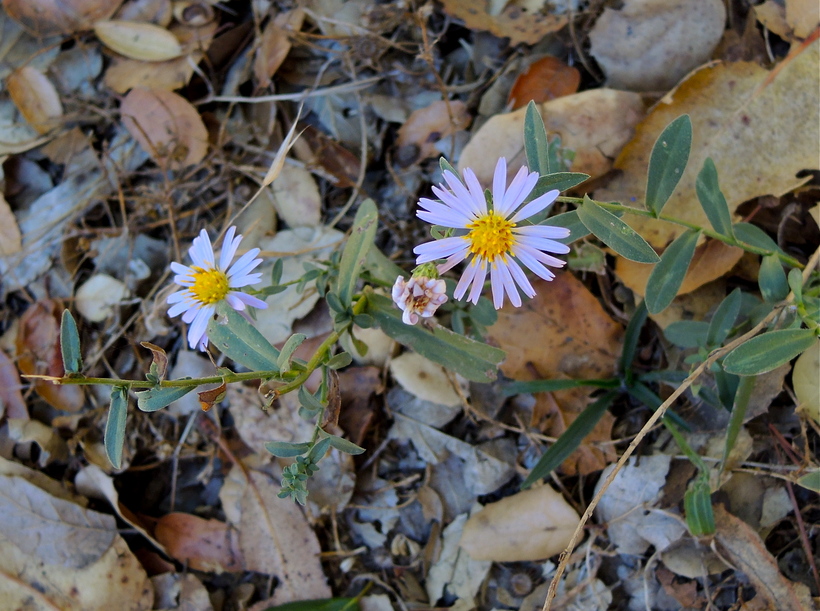
The cheerful California Aster (Symphyotrichum chilense) is a member of the Sunflower family that's native to coastal California. This perennial blooms from summer to fall, making it a good garden companion for other plants that have a spring blooming season. Its petite flowers bloom in subtle shades of blue and lavender. Butterflies and moths are attracted to the nectar. California Aster is a host plant for several species of both insects. Birds eat the seeds after blooming.
California Aster likes loamy clay soil and full or partial sun exposure. It does well in moist soil,but is also drought-adapted and can tolerate receiving little to no supplemental summer water. Cut this plant back to the ground in late fall or early winter. Deadheading produces more flowers, but in wildlife gardens it is often left to go to seed. New growth appears in late winter. It spreads easily by rhizomes; the low-growing 'Point Saint George' cultivar is often used as a groundcover plant.
Perennial herb
1 - 3 ft Tall
3 ft Wide
Fast
Winter Deciduous

Blue, Lavender, Yellow
Summer
Containers, Deer resistant
Partial Shade, Full Sun
Very Low, Low
Max 1x / month once established, Max 2x / month once established
Easy
Tolerates cold to 5° F
Medium, Slow, Standing
Prefers loamy clay soil.
Soil PH: 5.8 - 8.0
Can be cut back to the ground in winter. Deadhead during blooming season to produce more flowers.
For propagating by seed: No treatment. "Seeds are from the flowers, they are connected to little fluffy bits that fly in the wind. Detatching the fluff from the seeds is not worth the time. Rather take a handful of collected seed fluff and sprinkle it in the desired area. Seeds sprout within a week. This plant looks like a common weed but is not. Be aware of this when pulling weeds in your garden." (JT)
1, 2, 3, 4*, 5*, 6*, 7*, 8*, 9*, 10*, 11, 14*, 15*, 16*, 17*, 18*, 19*, 20*, 21*, 22*, 23*, 24*
Grassy places, salt marshes, disturbed places
Chaparral, Foothill Woodland, Freshwater Marsh, Mixed Evergreen Forest, Valley Grassland, Yellow Pine Forest, Wetland-Riparian
Works well with many shrubs and perennials, especially central coast species
Butterflies and moths supported
0 confirmed and 10 likely
Salt-and-Pepper Geometer
Biston betularia
Northern Checkerspot
Chlosyne palla
Dingy Cutworm
Feltia jaculifera
Symphyotrichum chilense - The Watershed Nursery. (n.d.). https://www.watershednursery.com/nursery/plant-finder/symphyotrichum-chilensis/