

Carried by 0 nurseries
View Availability at NurseryData provided by the participants of the Consortium of California Herbaria
View additional distribution information on the Jepson eflora
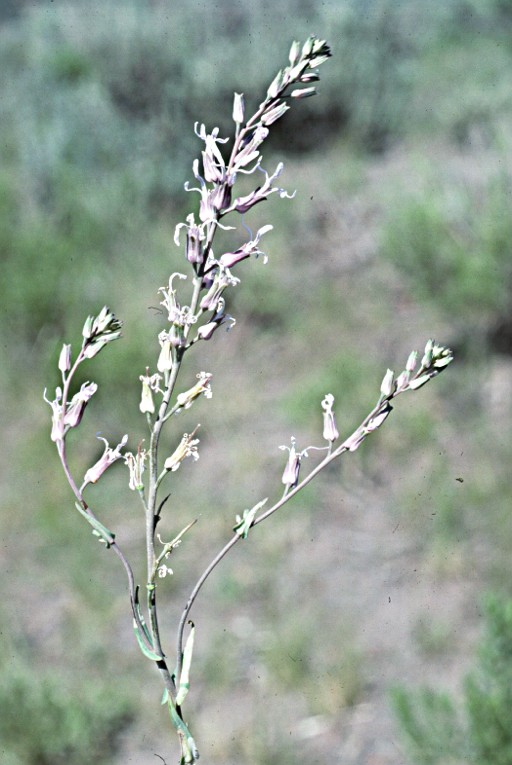
Thelypodium howellii, the Howell's thelypody or Howell's thelypodium, is a rare plant of the Western United States. It is endemic to a relatively small area on the borders of three western States: Oregon, Nevada, and California. The Thelypodium howellii plant is biennial. It is often somewhat hairy, especially near the base, but may be hairless and waxy in texture. It produces a slender, branching, erect stem up to 70 centimeters tall. The leaves are mostly located in a rosette around the base. Leaves located higher on the stem may have clasping bases. The inflorescence is a raceme of widely spaced flowers with greenish white or purplish sepals and pale blue or purple, spoon-shaped petals. The fruit is a silique up to 4. 5 centimeters long containing plump brown seeds. Subspecies. Thelypodium howellii subsp. howellii Thelypodium howellii subsp. spectabalis - Howell's spectacular thelypody. Distribution, habitat, and ecology. This plant is endemic to a small area stretching from north-eastern Oregon to north-eastern California. It lives in alkaline or adobe meadows and seeps, river valleys and moist plains in Great Basin sagebrush scrub. Howell's thelypody flowers from May to July. Var. spectabilis, known only from Malheur Co., Oregon, is larger than var. howellii, has larger, more strongly purple flowers, and is a federally listed species.
Perennial herb
2 ft Tall

Green, Blue, Purple, White, Brown
Sagebrush Scrub
Butterflies and moths supported
0 confirmed and 2 likely
Becker's White
Pontia beckerii
Western White
Pontia occidentalis