

Carried by 15 nurseries
View Availability at NurseryData provided by the participants of the Consortium of California Herbaria
View additional distribution information on the Jepson eflora
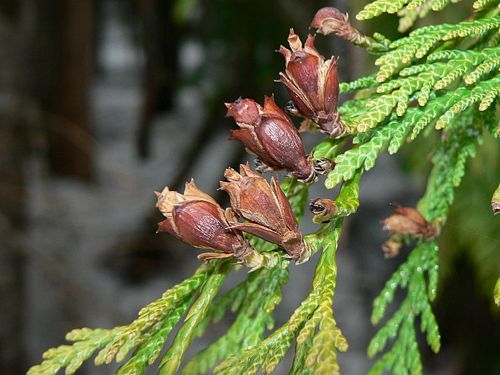
Western red cedar (Thuja plicata), also Western redcedar, is a species of Thuja, an evergreen coniferous tree in the cypress family Cupressaceae. In the American horticultural trade, it is also known as the Giant Arborvitae, Arborvitae being another name for its genus. Western red cedar is the Provincial tree of British Columbia, and has extensive applications for the indigenous First Nations of the Pacific Northwest. The western red cedar is not actually a cedar (Cedrus), but belongs in the Cupressaceae family, along with cypresses. It is known by many names, Pacific red cedar, British Columbia cedar, canoe cedar, giant cedar, or just red cedar. Plicata, the species name, derives from a Greek word meaning "folded in plaits", a references to the pattern of its small leaves. It is one of two arborvitaes (Thuja) native to North America. Arborvitae comes from the Latin for "tree of life". Coincidentally, native Americans of the West coast also address the cedar as "long life maker".
Western red cedar is valued for many industrial uses, including roof shingles, construction and cedar chests. It is allergenic, can cause asthma, and construction workers are advised to limit exposure.
Left to itself, it will grow above 200 '. It can be pruned and trained to become a thick 6' tall hedge.
Tree
40 - 230 ft Tall
Pyramidal, Upright Columnar
Fast, Moderate, Slow
Evergreen
Pleasant
Spring
Bank stabilization, Hedge
Full Sun, Partial Shade, Deep Shade
Moderate
Keep moist
Moderate
Tolerates cold to -15° F
Fast, Medium, Slow
Prefers loamy soils.
Soil PH: 5.0 - 7.0
Prune in winter when wood boring insects are less active.
For propagating by seed: 1-2 mos. stratification or soak in 0.2% potassium nitrate overnight (Association of Official Seed Analysts 1981). No treatment may give satisfactory germination ( USDA Forest Service 1948).
1, 2, 3, 4*, 5*, 6*, 7*, 8, 9, 14*, 15*, 16*, 17*, 18*, 19*, 20*, 21*, 22*, 23*, 24*
Forests
North Coastal Coniferous Forest, Wetland-Riparian
Butterflies and moths supported
31 confirmed and 5 likely
Common Gray
Anavitrinella pampinaria
Rusty Shoulder Knot Moth
Aseptis binotata
Pale Beauty
Campaea perlata