

Carried by 4 nurseries
View Availability at NurseryData provided by the participants of the Consortium of California Herbaria
View additional distribution information on the Jepson eflora
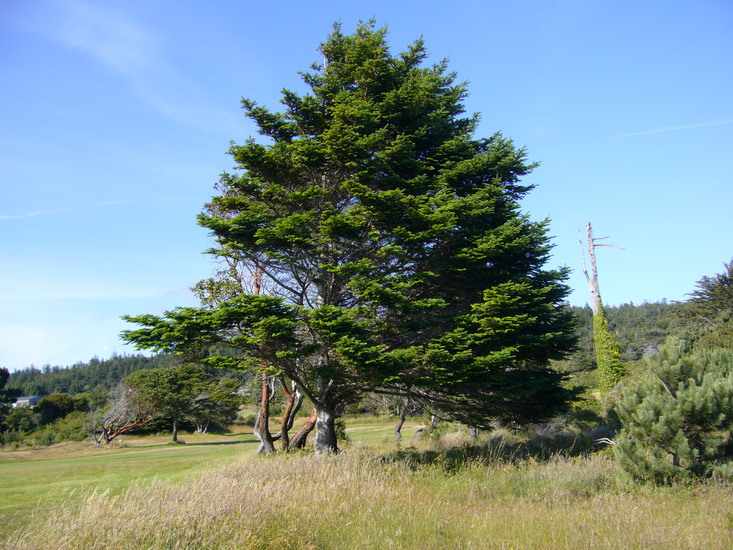
Abies grandis (Grand Fir, Giant Fir, Lowland White Fir, Great Silver Fir, Western White Fir, Vancouver Fir, or Oregon Fir) is a fir native to the Pacific Northwest of North America, occurring at altitudes of sea level to 1,800 meter. It is a large evergreen coniferous tree growing to 40-70 meter (exceptionally 80 meter) tall and with a trunk diameter of up to 2 meter. The leaves are needle-like, flattened, and grow in a single flat plane, 3-6 centimeter long and 2 millimeter wide by 0.5 millimeter thick, slightly notched at the tip. The leave color is glossy dark green above, and green-white below. The leaf arrangement is spiral on the shoot, but with each leaf variably twisted at the base so they all lie in two more-or-less flat ranks on either side of the shoot. The cones are 6-12 centimeter long and 3.5-4.5 centimeter broad, with about 100-150 scales. The winged seeds are released when the cones disintegrate at maturity about 6 months after pollination.
Tree
25 - 240 ft Tall
Pyramidal
Moderate
Evergreen
Spring
Deep Shade, Partial Shade
Moderate
Moderate
Prefers sandy or loamy soils. Does not grow well in clay soils.
For propagating by seed: 1 mo. stratification; for small lots of seeds, scarification may give better results. No treatment can also give good results (USDA Forest Service 1974).
2, 3, 4*, 5*, 6*, 7*, 14, 15*, 16*, 17*, 18, 19, 20, 21, 22, 23, 24
Mixed Evergreen Forest, North Coastal Coniferous Forest
Butterflies and moths supported
29 confirmed and 33 likely
Rusty Shoulder Knot Moth
Aseptis binotata
Douglas-Fir Cone Moth
Barbara colfaxiana
Modoc Budworm
Choristoneura retiniana