

Carried by 0 nurseries
View Availability at NurseryData provided by the participants of the Consortium of California Herbaria
View additional distribution information on the Jepson eflora
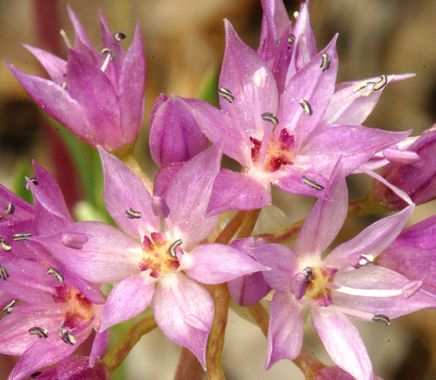
Allium bisceptrum, also known as the twincrest onion, is a high elevation plant native to western United States. It is a perennial that thrives under damp and shady conditions or open meadows in California, Arizona, New Mexico, Nevada, Oregon, Washington, Idaho, and Utah. Allium bisceptrum is used sometimes as food flavoring as their leaves may be very strong and odorous. Natives pray before picking the leaves of this plant. Many animals in the region, including elk, black bears and prairie dogs eat the bulbs of the wild onions. In California, A. bisceptrum is distributed throughout the counties of Alpine, El Dorado, Glenn, Inyo, Lassen, Mendocino, Mono, Modoc, Mariposa, Nevada, Plumas, San Bernardino, San Diego, Shasta, Sierra, Trinity, Tulare, and Tuolumne. It is also widely distributed in Nevada, Utah, Arizona, southeastern Oregon, and southern Idaho with isolated populations reported from northern Idaho and from southeastern Washington (Franklin County). The twincrest onion is a perennial at altitudes ranging from 2000 to 2900 meters. They grow up to anywhere between ten to forty cm high. The onion bulbs are round and egg-shaped. The bulbs have a light tint and when cut, has a powerful odor. Their flower heads are about 10-15 mm in length. The flowers are a lightly tinted purple. Each flower head contains usually six petals with pointed tips. Their flat leaves usually come in pairs of two or three and give off an odor when scratched. Habitat and ecology. Allium bisceptrum is found in forests dominated by yellow pine, red fir, and lodgepole pine, and wetland-riparian habitats in California. The twincrest onion thrives near streambanks and meadows. It is also likely to occur in wetlands.
Perennial herb, Geophyte
4 - 24 in Tall

Purple
Partial Shade
Moderate
Meadows and aspen groves
Lodgepole Forest, Red Fir Forest, Yellow Pine Forest, Wetland-Riparian
Butterflies and moths supported
0 confirmed and 14 likely
Ipsilon Dart
Agrotis ipsilon
Rascal Dart
Agrotis malefida
The Nutmeg
Anarta trifolii
Fruit-Tree Leafroller Moth
Archips argyrospila