

Carried by 21 nurseries
View Availability at NurseryData provided by the participants of the Consortium of California Herbaria
View additional distribution information on the Jepson eflora
Soap plant (Chlorogalum pomeridianum) is a member of the Agavaceae (Agave) family, but more closely resembles a Lily.
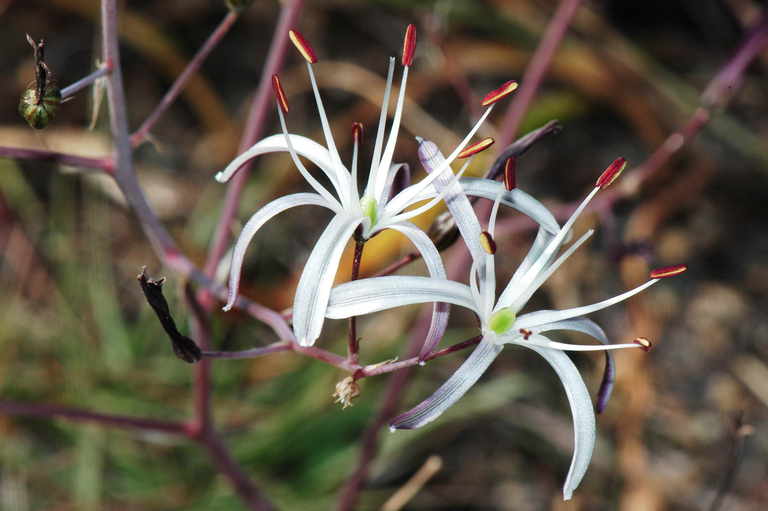
Soap plant has delicate, star-like flowers in clusters. They are typically white, with a noticeable purple or green mid-vein and yellow-to-orange stamens. Soap plant flowers are unique in that they open only in the late afternoon or evening, sometimes on cloudy days. The flowers remain open during the night but will close by the morning. Pollination is by evening and night flying insects.
As the plant's common name indicates, the leaves usually have edges that are wavy. The plant is drought-deciduous, and its foliage usually disappears by late summer. Once established, Soap Plant requires virtually no care.
Indigenouse Peoples use the crushed bulbs and water to produce a lather for cleaning clothing and baskets. Soap plant is found in most of California except the desert regions and just into southwest Oregon. Wavy-leafed Soap Plant grows on rock bluffs, grasslands, chaparral, and in open woodlands.
Perennial herb, Geophyte
3 ft Tall
2 ft Wide
Summer Deciduous
Slight

White
Spring, Summer
Containers, Deer resistant
Full Sun, Partial Shade
Very Low
Never irrigate once established
Moderate
Tolerates cold to 5° F
Medium
Tolerates a variety of soils.
Soil PH: 5.5 - 8.0
For propagating by seed: No treatment.
Seasonally dry bluffs, slopes, and flats as part of grassland, sage scrub, chaparral, or woodland habitats.
Chaparral, Closed-cone Pine Forest, Coastal Sage Scrub, Foothill Woodland, Mixed Evergreen Forest, Northern Coastal Scrub, Valley Grassland
Use as a filler between small trees or chaparral shrubs, or in grasslands, meadows, or rock gardens, along with native grasses; other geophytes such as Mariposa Lily (Calochortus spp.) or Blue Dicks (Dichelostemma capitatum); or with succulents such as Dudleya spp. and various cactus species.
Butterflies and moths supported
1 confirmed and 0 likely
The Brown Elfin
Callophrys augustinus
Lady Bird Johnson Wildflower Center - The University of Texas at Austin. (n.d.). Www.wildflower.org. Retrieved October 20, 2023, from https://www.wildflower.org/plants/result.php?id_plant=CHPO3