

Carried by 0 nurseries
View Availability at NurseryData provided by the participants of the Consortium of California Herbaria
View additional distribution information on the Jepson eflora
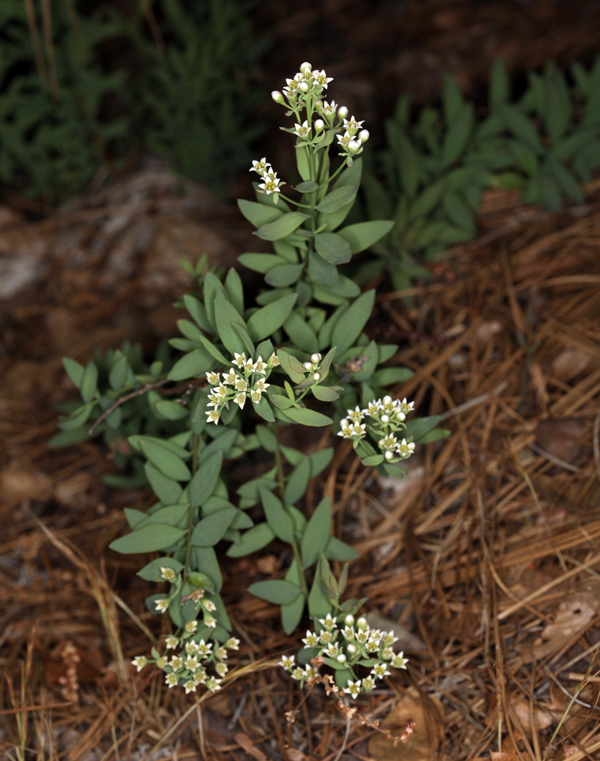
Comandra is a monotypic genus containing the single species Comandra umbellata. Its common names include bastard toadflax, umbellate bastard toadflax, and common comandra. The plant has a disjunct distribution; its four subspecies occur in North America and the Mediterranean. Comandra is a perennial herb growing about 8 to 34 cm tall. The leaves are up to 3. 3 cm long and are alternately arranged. The flowers lack petals, but have five greenish-white sepals. The flowers are insect-pollinated. The fruit is a drupe. Subspecies include:C. u. ssp. californica - California bastard toadflaxC. u. ssp. pallida - pale bastard toadflax, pine bastard toadflaxC. u. ssp. umbellataC. umbellata is semiparasitic; it is not holoparasitic as it obtains some nutrition through photosynthesis. It has a wide host range, parasitizing over 200 known plant species. These include Aster, Antennaria, Solidago, Rosa, Rubus, Fragaria, Vaccinium, Acer, Betula, Populus, Carex, and some grasses. Uses. A decoction of the plant parts was made by the Navajo people for narcotic and other medicinal usage. In times of food shortage, the berries were used by Native Americans as a food source, and though small, they have a sweet taste. Pathogens. C. umbellata is the alternate host for the comandra blister rust (Cronartium comandrae), a rust fungus that affects pine species in North America. Comandra blister rust can cause tree losses of up to 7% in some regions where it is common. When C. umb is infected by the rust aeciospores from the pine host, yellow, blister-like spots bearing urediniospores appear on the leaves of the plant within 20 days. In the following weeks, teliospores develop on brown, hairlike telia that germinate to produce basidiospores, the fungal life stage capable of infecting pines.
Perennial herb
3 - 13 in Tall

White, Green
Mixed Evergreen Forest, Red Fir Forest, Sagebrush Scrub, Yellow Pine Forest
Butterflies and moths supported
0 confirmed and 2 likely
Oblique-Banded Leafroller Moth
Choristoneura rosaceana
Red Swordgrass Moth
Xylena nupera