

Carried by 32 nurseries
View Availability at NurseryData provided by the participants of the Consortium of California Herbaria
View additional distribution information on the Jepson eflora
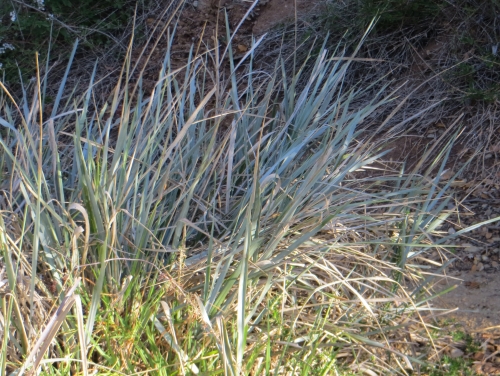
Giant wildrye (Elymus condensatus) is a grass that grows in bunches or clumps, has a distinctive silver blue hue, and does not die back in any season. It grows in California and northern Mexico in coastal sage scrub, chaparral and woodlands, rarely in wetlands.
This grass makes a nice drought-tolerant lawn substitute. It spreads by rhizomes (underground roots) but not rapidly; it can be easily contained in the area you want it to fill.
It often hybridizes with Leymus triticoides, producing the common hybrid grass Leymus x multiflorus. The cultivar 'Canyon Prince' from the Channel Islands is often used in landscapes or gardens because it is somewhat smaller and more compact.
Giant wildrye supports butterflies and moths.
Grass
3 - 6 ft Tall
2 - 8 ft Wide
Fountain, Weeping
Moderate
Evergreen
None

Brown
Deer resistant, Groundcover, Lawn alternative
Full Sun
Very Low
Max 1x / month once established
Easy
Tolerates cold to 15° F
Fast, Medium, Slow
Tolerant of sand and clay.
Tolerates serpentine soil..
Soil PH: 5.0 - 8.0
Can be pruned back to the ground in summer if it becomes floppy. Remove rhizomes to control spread
Can be propagated from rhizomes cut from the mother plant in Spring. For propagating by seed: No treatment.
7*, 8, 9, 10, 11, 12, 14*, 15*, 16*, 17*, 18*, 19*, 20*, 21*, 22*, 23*, 24*
Near the coast, in dry slopes, open places as a component of coastal sage scrub or chaparral. In inland valleys and foothill areas it is associated with oak woodlands. It is also found in some high desert areas with Joshua tree woodland
Chaparral, Foothill Woodland, Joshua Tree Woodland, Southern Oak Woodland
California Encelia, California Sagebrush (Artemisia californica), Coyotebrush, Oaks, Salvia spp., Eriogonum spp.
Butterflies and moths supported
2 confirmed and 10 likely