

Carried by 2 nurseries
View Availability at NurseryData provided by the participants of the Consortium of California Herbaria
View additional distribution information on the Jepson eflora
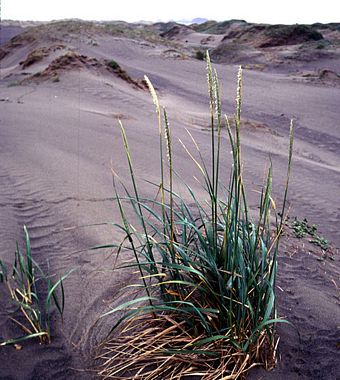
Leymus mollis (syn. Elymus mollis) is a species of grass known by the common names American dune grass, American dune wild-rye, sea lyme-grass, strand-wheat, and strand grass. Its Japanese name is hamaninniku. It is native to Asia, where it occurs in Japan, China, Korea, and Russia, and northern parts of North America, where it occurs across Canada and the northern United States, as well as Greenland. It can also be found in Iceland. This grass usually grows in coastal habitat, especially on dunes. It can be an important part of dune ecology. The grass usually grows on the foredune and on embryo dunes, less often on the backdune. It is one of the very first plants to establish in the process of ecological succession in the early stages of the development of a sand dune. In these loose dunes facing the ocean the plants tolerate salt spray, salty sand, little to no fresh water, unstable substrates, occasional inundation during storms, low nutrient levels, and abrasion by wind, water, and ice storms. Seedlings may become buried. This type of environment causes stress in a plant. The grass grows from a large rhizome that anchors it into shifting and unstable sands. When there are many plants on a dune, their rhizomes form a network that helps to stabilize it, preventing erosion. The network becomes "the skeleton of the foredune. " This makes the grass a valuable species for landscape rehabilitation in native beach habitat.
Grass
4 ft Tall

Brown
Full Sun
Very Low
Fast
Sandy beaches
Coastal Strand
Butterflies and moths supported
0 confirmed and 7 likely
Glassy Borer
Apamea devastator
Meadow Wainscot Moth
Leucania farcta