

Carried by 65 nurseries
View Availability at NurseryData provided by the participants of the Consortium of California Herbaria
View additional distribution information on the Jepson eflora
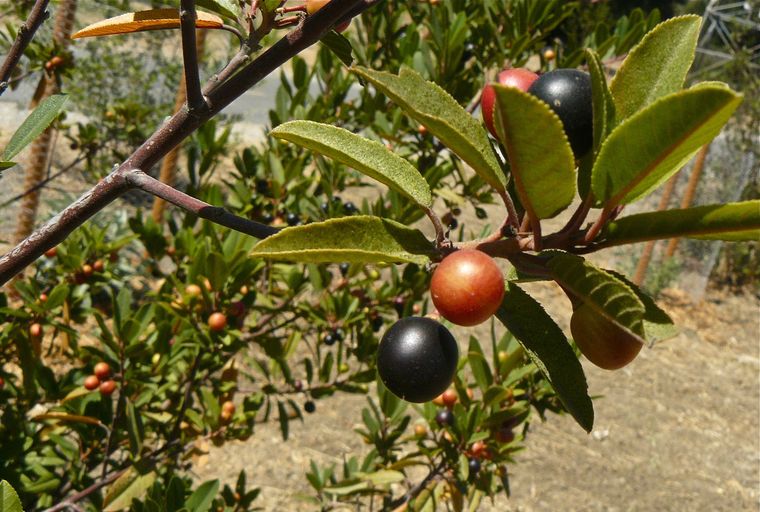
Coffeeberry (Frangula californica) is a dense evergreen shrub with dark red branches and oval leaves that are an attractive dark green with reddish tint. The flowers are inconspicuous, small and greenish-white. The plant is prized more for its fruit, which turns red, then purple, and finally black over the summer. The fruits attract a variety of birds.
This shrub is beautiful and easy to grow. It tolerates a wide variety of soil types and likes either full sun or part shade. It is moderately garden tolerant, and takes low water but accepts light summer water up to 2 times per month.
Coffeeberry has a dense form and is easy to prune. It makes a great and fire resistant hedge. There are six subspecies, some of which are restricted to certain parts of its range or certain growing requirements. There are also several horticultural varieties including 'Eve Case' and 'Mound San Bruno'. Select one that best fits your locations and conditions.
Shrub
6 - 15 ft Tall
5 - 15 ft Wide
Mounding, Rounded, Spreading
Moderate
Evergreen
None

Green, Cream, White
Summer, Spring
Bank stabilization, Containers, Hedge
Full Sun, Partial Shade
Very Low, Low
Max 2x / month once established
Easy
Tolerates cold to 10° F
Fast, Medium
Tolerates a variety of soils, but some subspecies have specific soil affinities.
Soil PH: 5.0 - 8.0
Takes pruning well. Upright forms may be pruned to form a hedge.
Seeds or cuttings. For propagating by seed: Fresh seeds need no treatment; stored seeds 3 months stratification.
This species is found in a wide variety of settings and habitats across the state, including coastal strand, foothill woodland slopes, sage scrub flats, chaparral, evergreen forest in mountain areas, rocky outcrops, sandy areas, stream banks, pinyon-juniper woodland in desert transition, and creosote bush scrub in high desert
Chaparral, Coastal Sage Scrub, Coastal Strand, Creosote Bush Scrub, Foothill Woodland, Joshua Tree Woodland, Mixed Evergreen Forest, Northern Coastal Scrub, Pinyon-Juniper Woodland, Red Fir Forest, Forest, Yellow Pine Forest
Because the species is found in various habitats throughout the state and is tolerant of garden conditions, it can be combined with a wide variety of trees and shrubs.
Butterflies and moths supported
10 confirmed and 23 likely
Orange Tortrix Moth
Argyrotaenia franciscana
Elegant Sheepmoth
Hemileuca eglanterina