

Carried by 0 nurseries
View Availability at NurseryData provided by the participants of the Consortium of California Herbaria
View additional distribution information on the Jepson eflora
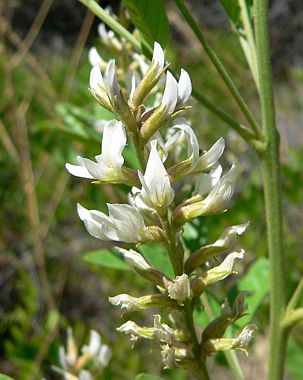
American Licorice (Glycyrrhiza lepidota) is a species of Glycyrrhiza native to most of North America, from central Canada south through the United States to California, Texas and Virginia, but absent from the southeastern states. It is also sometimes known in the United States as "wild licorice", to distinguish it from the related European Liquorice (Glycyrrhiza glabra) which is occasionally cultivated. The plant grows in moist soils; although it will grow in heavy soil it prefers sandy soil. It grows to 40-100 centimeter (16-40 inches) tall, and has long tough brown roots which are said to be sweet and were used as food and for medicinal purposes by Native Americans. American Licorice is not sweet from sugar but from glycyrrhizin, the acid ammonium salt of the tri-basic acid, glycyrrhizic acid. Glycyrrhizin may increase blood pressure (aka hypertension) by interfering with cortisol conversion.
This plant slowly spreads by rhizome to form large patches. Bumblebees are attracted to the flowers, and this plant is a host for several butterfly plant. Wild licorice is a rare in native plant gardens, but has lots of value for wildlife, does great in heavy soils, and is tolerant of both shade and full sun. It grows well with other riparian forest species like Leymus triticoides and Carex barbarae.
Perennial herb
1 - 4 ft Tall
Spreading, Upright
Moderate

White
Summer, Spring
Full Sun
Moderate, High
Medium, Slow
Prefers sandy soils.
Germinates readily from seed. Seed must be removed from barbed seed-pods first. Pre-soaking and hot water treatment appears to improve germination.
1, 2, 3, 4, 5, 6*, 7*, 8, 9, 10, 11, 12, 14*, 15*, 16*, 17*, 18*, 19*, 20*, 21*, 22*, 23*, 24*
Moist, open places, disturbed places
Chaparral, Foothill Woodland, Lodgepole Forest, Red Fir Forest, Subalpine Forest, Valley Grassland, Yellow Pine Forest, Wetland-Riparian
Butterflies and moths supported
3 confirmed and 2 likely
Marine Blue
Leptotes marina
Melissa Blue
Plebejus melissa
Gray Hairstreak
Strymon melinus
Orange Sulphur
Colias eurytheme