

Carried by 42 nurseries
View Availability at NurseryData provided by the participants of the Consortium of California Herbaria
View additional distribution information on the Jepson eflora
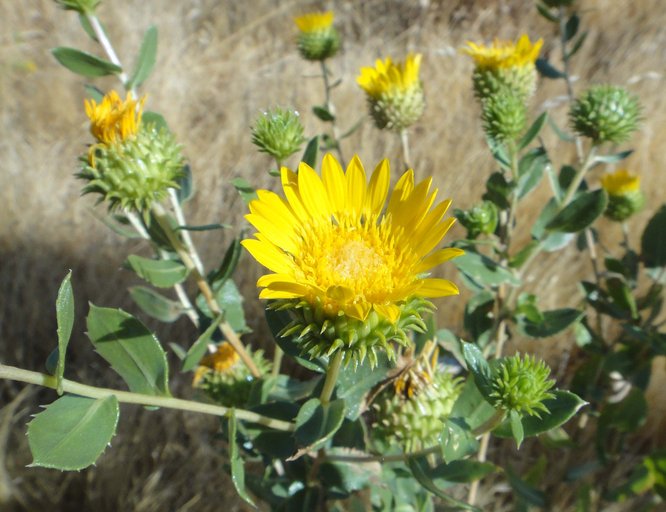
Grindelia camporum is a species of flowering plant in the daisy family known by the common names Great Valley gumplant and Great Valley gumweed. The plant is native to California and Baja California, where it can be found in a number of habitats including chaparral and woodlands. Its range may extend into Nevada. It is hardy plant that also readily grows in disturbed and altered areas such as ditches and roadsides. Grindelia camporum is a gangly perennial up to 2 m (6 ft. ) in maximum height but usually less. Its erect, branching stems are lined with many stiff, wavy-edged, serrated leaves 2 to 3 cm long. Atop the stem branches are inflorescences of a single large flower head up to 3 cm wide. The head is a vaguely thistlelike cup of green clawlike phyllaries that bend downward. The centre of the head is filled with yellow disc florets and there are usually many yellow ray florets around the circumference. The flower head fills with a copious white exudate, especially during the early stages of blooming. It is a traditional Native American medicinal plant, used by the Indigenous peoples of California and also a major pollinator attractant.
Perennial herb
2 - 7 ft Tall
3 ft Wide
Moderate
Summer Semi-deciduous

Yellow
Summer, Spring, Fall
Deer resistant
Full Sun
Very Low, Low
Max 1x / month once established
Easy
Tolerates cold to 15° F
Fast, Medium, Slow
Adaptable.
Tolerates saline soil..
Soil PH: 6.0 - 8.0
For propagating by seed: No treatment.
7*, 8*, 9*, 14*, 15*, 16*, 17, 18, 19*, 20*, 21*, 22, 23, 24
Sandy or saline bottomlands of interior valleys, also mountains to 4, 000 ft., coastal bluffs, and rocky cliffs on the Channel Islands
Chaparral, Coastal Sage Scrub, Valley Grassland, Wetland-Riparian
Because this plant is fairly widespread across the state, companion plants will depend on locality but may include native grasses, Penstemon spp., Lupines (Lupinus spp.), Poppies (Eschscholzia spp. or Papaver spp.), and various native cactus and succulents.
Butterflies and moths supported
2 confirmed and 9 likely
Orange Tortrix Moth
Argyrotaenia franciscana
Bordered Patch
Chlosyne lacinia