

Carried by 0 nurseries
View Availability at NurseryData provided by the participants of the Consortium of California Herbaria
View additional distribution information on the Jepson eflora
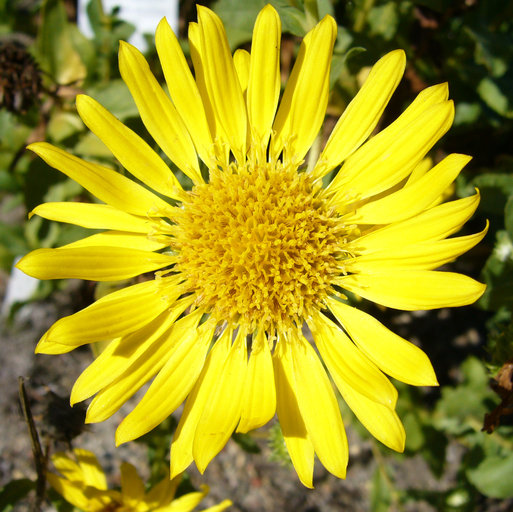
Suisun Gumplant (Grindelia paludosa) is a putative stabilized hybrid between Grindelia camporum and Grindelia stricta var. angustifolia. It is endemic to the Suisun Bay Area, in the Deltaic Great Valley bioregion of California, growing in salt marshes and banks of sloughs. Its flowering time is between July and November.
Some botanists consider Grindelia paludosa a synonym for Grindelia hirsutula, a North American species of flowering plant in the daisy family known by the common names hairy gumplant and hairy gumweed. Grindelia hirsutula is native to North America, widespread across Canada and in California and Oregon. The species is highly variable, and many local populations have been named as varieties or as distinct species. All these taxa do, however, intergrade with one another. Grindelia hirsutula is an erect perennial herb or subshrub sometimes as much as 250 cm (100 inches or 8 1/3 feet) tall but usually much shorter. The plant is usually green but the stems are often red or purplish-brown and the leaves can be somewhat yellowish to reddish. The plant can produce numerous flower heads in branching arrays at the top of the plant. Each head is 2 or 3 centimeters (0. 8-1. 2 inches) wide with hemispheric cups of greenish phyllaries around the base, the bracts claw-like and bent away from the flowers. The center of the head is filled with many small yellow disc florets surround by numerous golden ray florets. The head produces a thick white exudate, especially in new flower heads.
Varieties: Grindelia hirsutula var. maritima - San Francisco Gum Plant, San Francisco gumplant, coastal gumweed; is endemic to the the San Francisco Bay Area in coastal northern California.
Perennial herb
8 ft Tall

Yellow
Summer, Fall
Salt marshes, slough banks
Butterflies and moths supported
0 confirmed and 4 likely
Spotted Straw Sun Moth
Heliothis phloxiphaga
Sunflower Moth
Homoeosoma electella
Western Yellowstriped Armyworm
Spodoptera praefica