

Carried by 8 nurseries
View Availability at NurseryData provided by the participants of the Consortium of California Herbaria
View additional distribution information on the Jepson eflora
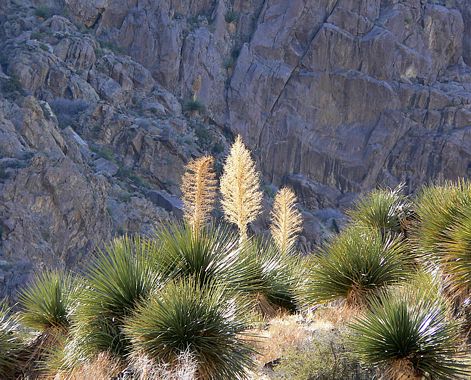
Nolina parryi (Parry's Nolina or Giant Nolina) is a flowering plant in the family Ruscaceae. It grows in the upper elevations of the Peninsular Range, the Mojave Desert and the southern Sierra Nevada.up to 2100 meters. It can exceed two meters in height, its flower cluster reaching 4 meters. The trunk is up to 60 centimeters in diameter. Leaves are borne in dense rosettes, each with up to 220 stiff linear leaves up to 140 centimeters long and 4 broad. It is dioecious, with separate male and female plants; the flowers are white, produced on the tall plume-like flower cluster that normally appears in late spring. The fruit is a delicate, papery, three-lobed pod.
This plant requires fast draining soil and dry slopes. It needs full sun. This plant is extremely drought tolerant, and after established, it should survive the dry months with no supplementary water. Since it's primarily a desert plant, it's evolved to handle summer monsoons, and tolerates occasional water (1x per month).
Perennial herb, Succulent
4 - 7 ft Tall
4 ft Wide
Fountain
Moderate
Evergreen

Cream, White
Spring
Groundcover, Hedge
Full Sun
Very Low, Low
Max 1x / month once established
Moderate
Tolerates cold to 25° F
Fast
This plant requires coarse, fast draining soil such as decomposed granite.
Soil PH: 6.0 - 7.5
The dried flower stalk can be left in place or pruned out.
By pups, cuttings or seeds. For propagating by seed: No treatment. (Everett 1957).
1, 2, 3, 7*, 8, 9, 11, 12*, 13, 14*, 15*, 16*, 17, 18*, 19*, 20*, 21*, 22*, 23*, 24*
Dry slopes and ridges, often very rocky, usually below 3, 600 ft. on the drier eastern flank of the mountains
Chaparral, Coastal Sage Scrub, Joshua Tree Woodland, Pinyon-Juniper Woodland
In desert settings, Joshua Tree, Apricot Mallow, Desert Brittlebush, Creosote Bush, Desert Agave, California Juniper, Pinyon Pine and Rush Milkweed. In chaparral settings, San Diego Viguiera, California Buckwheat (ssp. polifolium), Salvia spp., and Ceanothus species.
Butterflies and moths supported
0 confirmed and 2 likely
Gray Hairstreak
Strymon melinus