

Carried by 0 nurseries
View Availability at NurseryData provided by the participants of the Consortium of California Herbaria
View additional distribution information on the Jepson eflora
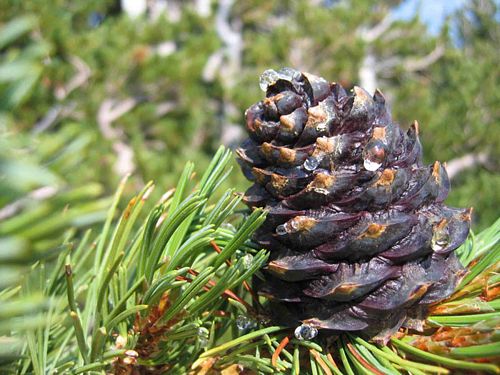
Pinus albicaulis (known commonly as Whitebark pine, Pitch pine, Scrub pine, and Creeping pine) occurs in the mountains of the Western United States and Canada, specifically the subalpine areas of the Sierra Nevada, the Cascade Range, the Pacific Coast Ranges, and the northern Rocky Mountains (including the Greater Yellowstone Ecosystem). The Whitebark Pine is typically the highest-elevation pine tree of these mountains, marking the tree line. Thus, it is often found as krummholz, trees dwarfed by exposure and growing close to the ground. In more favourable conditions, trees may grow to 20 meter in height, although some can reach up to 27 meter. It shares the common name Creeping pine with several other plants.
Tree
15 - 85 ft Tall
Upright
Slow

Yellow
Summer
Containers
Full Sun, Partial Shade
Prefers sandy or loamy soils. Does not grow well in clay soils.
For propagating by seed: 3-4 mos. stratification (USDA Forest Service 1974).
1*, 2*, 3*, 6, 7, 15, 16, 17
Subalpine Forest
Butterflies and moths supported
0 confirmed and 68 likely
Common Gray
Anavitrinella pampinaria
Polyphemus moth
Antheraea polyphemus
Western Pine Elfin
Callophrys eryphon