

Carried by 0 nurseries
View Availability at NurseryData provided by the participants of the Consortium of California Herbaria
View additional distribution information on the Jepson eflora
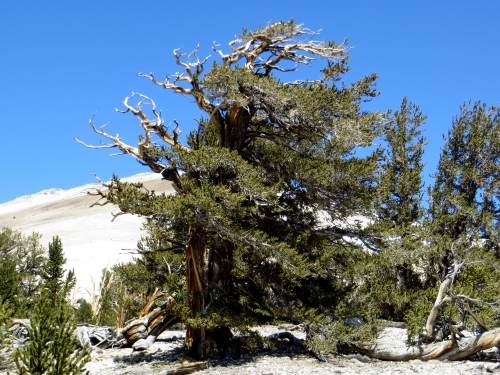
Pinus longaeva, the Great Basin Bristlecone Pine, is a long-living species of tree found in the higher mountains of the southwest United States. The species is one of three closely related trees known as bristlecone pines and is sometimes known as the Intermountain or Western bristlecone pine. It is a medium-size tree, reaching 5 to 15 meter (16 to 49 feet) tall and with a trunk diameter of up to 2.5 to 3.6 meter (8 feet 2 inches to 11 feet 10 inches) in diameter. The bark is bright orange-yellow, thin and scaly at the base of the trunk. The leaves ('needles') are in fascicles of five, stout, 2.5 to 4 centimeter (0.98 to 1.6 inches) long, deep green to blue-green on the outer face, with stomata confined to a bright white band on the inner surfaces. The leaves show the longest persistence of any plant, with some remaining green for 45 years (Ewers & Schmid 1981).
Tree
16 - 52 ft Tall
Containers
Full Sun, Partial Shade
Very Low
Moderate
Prune in winter when wood boring insects are less active.
For propagating by seed: Fresh seeds need no treatment; stored seeds 1 mo. stratification may improve germination ( USDA Forest Service 1974).
1, 2, 3, 4, 5, 6, 7, 15, 16, 17, 18, 19
Mountain tops, slopes, mesas
Bristlecone Pine Forest
Butterflies and moths supported
0 confirmed and 21 likely
Western Pine Elfin
Callophrys eryphon
Sugar Pine Tortrix Moth
Choristoneura lambertiana
Lodgepole Pine Needle-Miner
Coleotechnites milleri
Pandora Pinemoth
Coloradia pandora