

Carried by 5 nurseries
View Availability at NurseryData provided by the participants of the Consortium of California Herbaria
View additional distribution information on the Jepson eflora
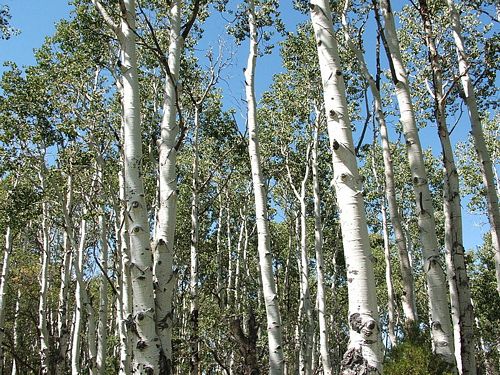
Populus tremuloides is a deciduous tree native to cooler areas of North America. The species is referred to as Quaking Aspen, Trembling Aspen, and Quakies, names deriving from its leaves which flutter in even a slight breeze. The tree can become tall, up to 25 meters, but is more often half that height, with smooth pale bark scarred with black. The glossy green leaves, dull beneath, become golden to yellow, rarely red, in Autumn. The species rarely flowers, often propagating through its roots to form large clonal groves. The quaking or trembling of the leaves is due to its flattened petioles. The specific epithet, tremuloides, is given for this trembling characteristic. Other species of Populus have petioles flattened partially along their length, while the Quaking Aspen's are flattened from side to side along the entire length of the petiole. This quaking of the leaves produces a soft sound that many consider a hallmark of the Quaking Aspen. It can be found in many parts of North America. In California it is most common in the Sierras and other high elevation mountains. Nurseries usually sell only male plants because female plants can produce large amounts of cottony seeds. Unless you have acreage, use caution in planting this tree because it will send out suckers long distances to quickly form a dense grove that will fill in any moist area. There are usually few understory plants in Quaking Aspen groves.
Tree
40 - 82 ft Tall
Rounded, Upright Columnar
Fast
Winter Deciduous

Blue, Cream, Yellow, Red
Spring
Bank stabilization
Full Sun, Partial Shade
Moderate
Max 1x / week once established
Easy
Tolerates cold to -10° F
Medium
Tolerates a variety of soils as adequate moisture is present.
Soil PH: 5.0 - 8.0
Quaking Aspen can be sheared to form a hedge or screen
For propagating by seed: No treatment. Use fresh seeds, usually viable only a few days. Seeds should not be covered or pressed into medium; seedbed should be kept saturated for first mo. Easily propagated from stem cuttings.
1*, 2*, 3, 4*, 5*, 6*, 7*, 14, 15, 16, 17, 18*, 19, 20, 21
Streamsides, moist openings and slopes at higher elevations
Lodgepole Forest, Red Fir Forest, Subalpine Forest, Wetland-Riparian
This tree has few garden companions due to its tendency to spread. However, given a large enough area it could be planted with other mountain species
Butterflies and moths supported
98 confirmed and 40 likely
Sallow Button
Acleris hastiana
Aspen Carpenterworm Moth
Acossus populi
Fingered Dagger Moth
Acronicta dactylina