

Carried by 10 nurseries
View Availability at NurseryData provided by the participants of the Consortium of California Herbaria
View additional distribution information on the Jepson eflora
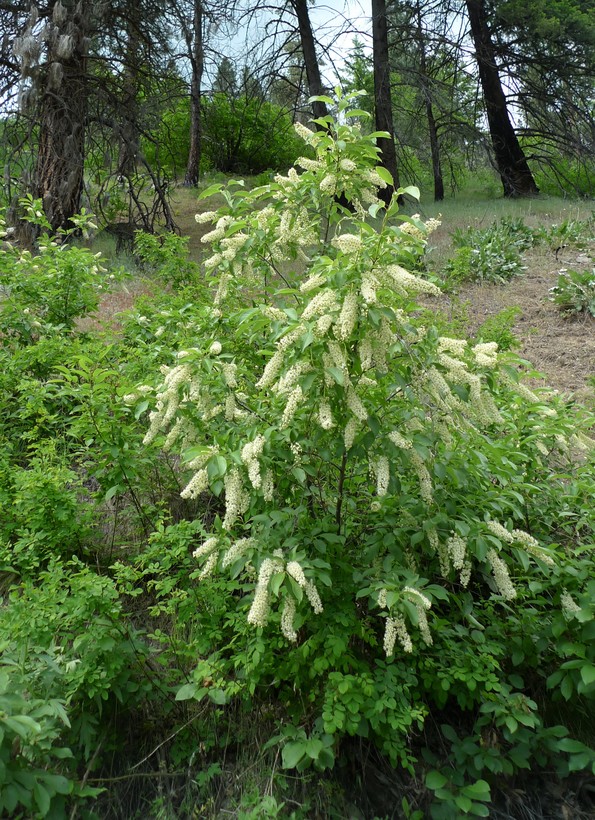
Choke Cherry (Prunus virginiana) is a species in the Rosaceae (Rose) family, in the Bird Cherry (Padus) subgenus. It is native to North America where it is found almost throughout the continent except for the deep south and the far north. The plant is widespread in California, particularly in the mountains. It is a suckering shrub or small tree growing to 5 meter tall. The leaves are oval, 3-10 centimeter long, with a coarsely serrated margin. It is deciduous, and the leaves provide some fall color. The flowers are produced in racemes of 15-30 inches late spring (well after leaf emergence). The fruits are about 1 centimeter diameter, range in color from bright red to black. Although they are said to be edible, they contain small amounts of cyanide, especially when unripe. The very ripe berries are dark in color, less astringent, and contain less cyanide. Despite the potential toxicity, the fruits were valued by many Native people.
Tree, Shrub
15 - 25 ft Tall
10 - 20 ft Wide
Upright
Fast
Winter Deciduous
Pleasant

White
Spring
Bank stabilization, Hedge
Full Sun, Partial Shade, Deep Shade
Moderate
Max 2x / month once established
Easy
Tolerates cold to -15° F
Medium
Tolerates a variety of soils.
Soil PH: 5.2 - 8.4
For propagating by seed: 3 mos. stratification; 2 wks. warm stratification first may improve germination.
Rocky slopes
Chaparral, Foothill Woodland, Yellow Pine Forest, Wetland-Riparian
Use under trees such as Pines (Pinus spp.), Firs (Abies spp.), Oaks (Quercus spp.), Madrone (Arbutus spp.), Cottonwoods (Populus spp.), and Willows (Salix spp.), and with shrubs such as Dogwood (Cornus spp.), wild roses (Rosa spp.), and Currant/Gooseberry (Ribes spp.).
Butterflies and moths supported
46 confirmed and 122 likely
Destructive Pruneworm Moth
Acrobasis tricolorella
Fingered Dagger Moth
Acronicta dactylina
Triton Dagger Moth
Acronicta grisea
Fall Cankerworm Moth
Alsophila pometaria