

Carried by 0 nurseries
View Availability at NurseryData provided by the participants of the Consortium of California Herbaria
View additional distribution information on the Jepson eflora
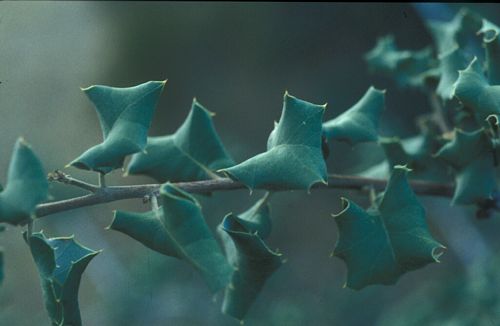
Quercus palmeri is a species of oak known by the common name Palmer oak, or Palmer's oak. It is native to California, Baja California, New Mexico, and in Arizona through the transition zone to the eastern Mogollon Rim, where it grows in canyons, mountain slopes, washes, and other dry habitat types. Quercus palmeri is a shrub or small tree growing up to 3 meters (10 feet) tall, but known to reach 6 meters (20 feet) at times. It branches into angular twigs and is reddish brown. The leaves are 1 to 3 centimeters (0. 4-1. 2 inches) in length. They are stiff, leathery, and brittle, their edges wavy with sharp spine-teeth. The upper surface is shiny, waxy, and olive green in color, the lower gray-green and coated with glandular hairs. The fruit is an acorn with a hairy cap up to 2. 5 centimeters (1 inch) wide and a blunt-ended nut 2 to 3 centimeters (0. 8-1. 2 inches) long. Quercus palmeri is a shrub or small tree growing up to 3 meters (10 feet) tall, but known to reach 6 meters (20 feet) at times. It branches into angular twigs and is reddish brown. The leaves are 1 to 3 centimeters (0. 4-1. 2 inches) in length. They are stiff, leathery, and brittle, their edges wavy with sharp spine-teeth. The upper surface is shiny, waxy, and olive green in color, the lower gray-green and coated with glandular hairs. The fruit is an acorn with a hairy cap up to 2. 5 centimeters (1 inch) wide and a blunt-ended nut 2 to 3 centimeters (0. 8-1. 2 inches) long. Quercus palmeri usually grows in small populations, some of which are actually cloned growths of a single plant. One such clone in the Jurupa Mountains in Riverside County, California, named the Jurupa Oak, was determined to be over 13,000 years old, a single individual living as a relict from the Pleistocene. It is therefore one of the oldest living plants in the world.
Shrub
10 - 20 ft Tall

Cream, Green
Bank stabilization, Hedge
Full Sun
For propagating by seed: Fresh seeds sow in fall outdoors or stratify to hold for spring sowing. (USDA Forest Service 1974).
7*, 8, 9*, 10, 11, 14*, 15*, 16*, 17, 18*, 19*, 20*, 21*, 22*, 23*, 24
Rocky slopes, flats
Chaparral
Butterflies and moths supported
0 confirmed and 137 likely