

Carried by 29 nurseries
View Availability at NurseryData provided by the participants of the Consortium of California Herbaria
View additional distribution information on the Jepson eflora
Fragrant sumac (Rhus aromatica) is a shrub in the Anacardiaceae (Cashew) family; it has several other common names, including lemonade sumac. It was formerly classified as Rhus trilobata; some sources still refer to it that way.
It is native to western North America. It occurs in many parts of California, including the northern Coast Ranges, Sierra foothills, and southern coastal mountains. It can be found from deserts to mountain peaks up to about 7,000 feet in elevation.
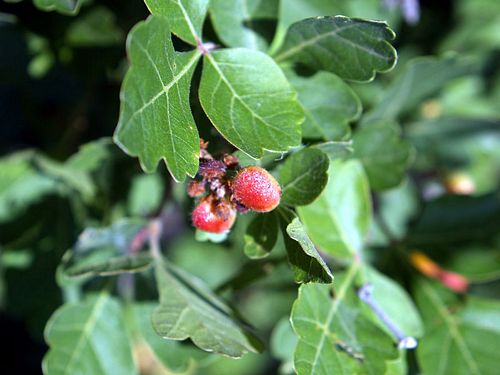
The pale yellow flowers are followed by a red, fleshy drupe that has a sticky coating, similar to lemonade berry (Rhus integrifolia). This species closely resembles other members of the genus that have leaves with three "leaflets" ("trifoliate" leaves), including poison oak. People with sensitivity to poison oak should use caution around fragrant sumac.
The shape of the leaflets and the habit of the shrub make this species, like some other Rhus species, resemble small-leafed oaks (Quercus). The plant is deciduous and exhibits good fall color.
Shrub
2 - 8 ft Tall
8 ft Wide
Mounding, Rounded
Moderate
Winter Deciduous

Yellow, Cream
Spring
Hedge
Full Sun
Low
Max 1x / week once established
Moderate
Tolerates cold to -15° F
Fast
Prefers sandy soil.
Soil PH: 6.0 - 8.0
For propagating by seed: Hot wa ter or soak in concentrated H2S04 1-3 hrs., then 2-3 mos. stratification.
1, 2, 3, 4, 5, 6*, 7*, 8, 9, 10, 14*, 15, 16, 17, 18*, 19*, 20*, 21*, 22, 23, 24
Slopes, washes, canyons, mesas, and desert mountains
Chaparral, Creosote Bush Scrub, Foothill Woodland, Pinyon-Juniper Woodland
Use with manzanita (Arctostaphylos spp.), western redbud (Cercis occidentalis), pines (Pinus spp.), oaks (Quercus spp.), juniper (Juniperus spp.), and most chaparral plants.
Butterflies and moths supported
0 confirmed and 20 likely
Western Avocado Leafroller Moth
Amorbia cuneana
Fruit-Tree Leafroller Moth
Archips argyrospila
Salt-and-Pepper Geometer
Biston betularia