

Carried by 3 nurseries
View Availability at NurseryData provided by the participants of the Consortium of California Herbaria
View additional distribution information on the Jepson eflora
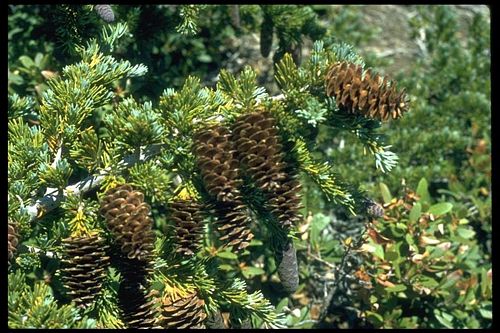
Tsuga mertensiana (Mountain Hemlock) is a species of hemlock native to the west coast of North America, with its northwestern limit on the Kenai Peninsula, Alaska, and its southeastern limit in northern Tulare County, California. It is a large evergreen coniferous tree growing to 20-40 meter tall, exceptionally 59 meter, and with a trunk diameter of up to 2 meter. The bark is thin and square-cracked or furrowed, and gray in color. The crown is a neat slender conic shape in young trees with a tilted or drooping lead shoot, becoming cylindric in older trees. At all ages, it is distinguished by the slightly pendulous branchlet tips. The shoots are orange-brown, with dense fine hair about 1 millimeter long. The leaves are needle-like, 7-25 millimeter long and 1-1.5 millimeter broad, soft, blunt-tipped, only slightly flattened in cross-section, pale waxy pale blue-green above, and with two broad bands of bluish-white stomata below with only a narrow green midrib between the bands; they differ from those of any other species of hemlock in also having stomata on the upper surface, and are arranged spirally all round the shoot. The cones are small, but much longer than those of any other species of hemlock, pendulous, cylindrical, 30-80 millimeter long and 8-10 millimeter broad when closed, opening to 12-35 millimeter broad, superficially somewhat like a small spruce cone. They have thin, flexible scales 8-18 millimeter long. The immature cones are dark purple (rarely green), maturing red-brown 5-7 months after pollination. The seeds are red-brown, 2-3 millimeter long, with a slender, 7-12 millimeter long pale pink-brown wing.
Tree
30 - 194 ft Tall
Upright
Slow
Evergreen

Yellow
Summer
Bank stabilization, Deer resistant
Full Sun, Partial Shade, Deep Shade
Low
Prefers sandy soils.
For propagating by seed: 3 mos. stratification (USDA Forest Service 1974).
1, 2*, 4, 5, 6*, 7, 14, 15, 16, 17
Forests
Subalpine Forest
Butterflies and moths supported
16 confirmed and 38 likely
Rusty Shoulder Knot Moth
Aseptis binotata
Mottled Gray Carpet
Cladara limitaria
Packard's Girdle Moth
Enypia packardata
Variable Girdle Moth
Enypia venata