

Carried by 6 nurseries
View Availability at NurseryData provided by the participants of the Consortium of California Herbaria
View additional distribution information on the Jepson eflora
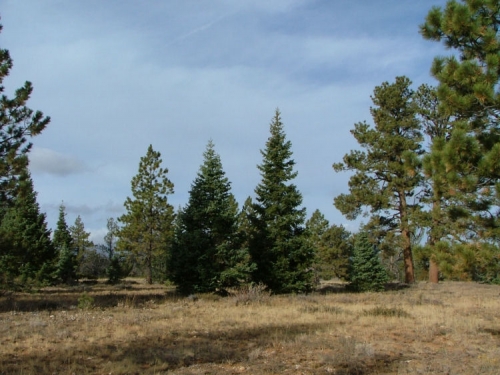
White Fir (Abies concolor) is a member of the Pinaceae (Pine) family native to the mountains of western North America, occurring at altitudes of 900-3,400 meter. In California it is quite common in the Sierras and North Coast Range, with scattered locations in the mountains of southern California. It is a medium to large evergreen coniferous tree growing to 25-60 meters tall and with a trunk diameter of up to 2 meters. The leaves are needle-like, flattened, 2.5-6 centimeter long and 2 millimeter wide by 0.5-1 millimeter thick, green to waxy pale blue-green above, and with two waxy pale blue-white bands of stomata below, and slightly notched to bluntly pointed at the tip. The leaf arrangement is spiral on the shoot, but with each leaf variably twisted at the base so they all lie in either two more-or-less flat ranks on either side of the shoot, or upswept across the top of the shoot but not below the shoot. The cones are 6-12 centimeter long and 4-4.5 centimeter broad, green or purple ripening pale brown, with about 100-150 scales; the scale leafs are short, and hidden in the closed cone. The winged seeds are released when the cones disintegrate at maturity about 6 months after pollination. This plant prefers higher elevations and cold winters; it needs extra care if grown outside its native range.
Tree
82 - 200 ft Tall
Pyramidal
Slow
Evergreen
Deep Shade, Full Sun, Partial Shade
Moderate
Easy
Tolerates cold to 25° F
Medium
Prefers rich, forest soil with well-decomposed organic component derived from decaying wood. For garden purposes add redwood compost to soil mix.
Soil PH: 5.0 - 7.1
Prune in winter when wood boring insects are less active.
For propagating by seed: 1 mo. stratification. Abies seed storage life is less than one year unless kept refrigerated. Sow A. concolor in late fall as there will be less seedling loss to disease if the first growth
1, 2, 3, 4*, 5, 6*, 7, 10*, 14*, 15, 16, 17, 18, 19, 20, 21, 22, 23, 24
Montane forests
Lodgepole Forest, Red Fir Forest, Yellow Pine Forest
Trees: Maple (Acer glabrum or macrophyllum), Incense Cedar (Calocedrus decurrens), Cherry (Prunus spp.), Oak (Quercus spp.), Jeffrey Pine (Pinus jeffreyi), and Bay Laurel (Umbellularia californica)
Shrubs: Manzanita (Arctostaphylos spp.), Ceanothus spp., Dogwood (Cornus spp.), Flannelbush (Fremontodendron spp.), Currant/Gooseberry (Ribes spp.), Sage (Salvia spp.), and Huckleberry (Vaccinium spp.)
Butterflies and moths supported
13 confirmed and 49 likely
Western Avocado Leafroller Moth
Amorbia cuneana