

Carried by 11 nurseries
View Availability at NurseryData provided by the participants of the Consortium of California Herbaria
View additional distribution information on the Jepson eflora
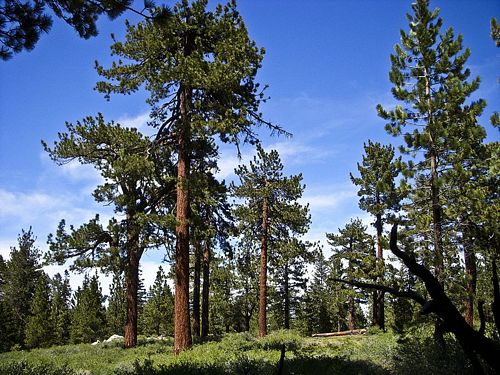
Jeffrey Pine (Pinus jeffreyi), named in honor of its documenter John Jeffrey, is a North American pine related to Ponderosa Pine. It occurs from southwest Oregon south through much of California, including the Sierras, Coast Ranges, Transverse Range and Peninsular Range, to northern Baja California, Mexico. It is a high altitude species; in the north of its range, it grows widely at 1,500 to 2,100 meter (4,900 to 6,900 feet) altitude, and at 1,800 to 2,900 meter (5,900 to 9,500 feet) in the south of its range. The Jeffrey Pine is a large tree, reaching 25 to 40 meter (82 to 131 feet) tall, rarely up to 53 meter (174 feet) tall, though smaller when growing at or near tree line. The leaves are needle-like, in bundles of three, stout, waxy pale gray-green, 12 to 23 centimeter (4.7 to 9.1 inches) long. The cones are 12 to 24 centimeter (4.7 to 9.4 inches) long, dark purple when immature, ripening pale brown, with thinly woody scales bearing a short, sharp inward-pointing barb. The seeds are 10 to 12 millimeter (0.39 to 0.47 inches) long, with a large (15 to 25 millimeter (0.59 to 0.98 inches)) wing. In the Sierras and Peninsular Range it grows primarily on granite, but in the Coast Ranges it is found largely on Serpentine soils. The bark has a distinctive fragrance described as reminiscent of vanilla, lemon, pineapple, violets, apple, or butterscotch. It is tolerant of drought, cold and heat.
Plant type
Tree
Size
40 - 180 ft Tall
Form
Upright
Growth rate
Fast
Dormancy
Evergreen
Fragrance
Pleasant

Color
Brown
Flowering season
Spring
Special uses
Deer resistant
Sun
Full Sun, Partial Shade
Water
Low
Summer irrigation
Max 2x / month once established
Ease of care
Easy
Cold tolerance
Tolerates cold to -15° F
Soil drainage
Medium
Soil description
Prefers rich, forest soil with well-decomposed organic component derived from decaying wood. For garden purposes add redwood compost to soil mix.
Tolerates serpentine soil..
Soil PH: 5.2 - 7.9
Maintenance
Prune in winter when wood boring insects are less active.
Propagation
For propagating by seed: Fresh seeds need no treatment; stored seeds 1-2 mos. stratification may improve germination (USDA Forest Service 1974).
Sunset Zones
1, 2, 3, 4*, 5*, 6*, 7, 8, 9, 14*, 15*, 16*, 17*, 18*, 19*
Site type
Forested mountains
Plant communities
Red Fir Forest, Yellow Pine Forest
Trees: White Fir (Abies concolor), Maple (Acer glabrum or macrophyllum), Incense Cedar (Calocedrus decurrens), Cherry (Prunus spp.), Oak (Quercus spp.), and Bay Laurel (Umbellularia californica)
Shrubs: Manzanita (Arctostaphylos spp.), Ceanothus spp., Dogwood (Cornus spp.), Flannelbush (Fremontodendron spp.), Currant/Gooseberry (Ribes spp.), Sage (Salvia spp.), and Huckleberry (Vaccinium spp.)
Butterflies and moths supported
4 confirmed and 93 likely
Confirmed
Likely
Sugar Pine Tortrix Moth
Choristoneura lambertiana
Pandora Pinemoth
Coloradia pandora
Ponderosa Pine Seedworm Moth
Cydia piperana
Nantucket Pine Tip Moth
Rhyacionia frustrana
Common names:
Visit About Us for general information about our data sources and terms of use.