

Carried by 15 nurseries
View Availability at NurseryData provided by the participants of the Consortium of California Herbaria
View additional distribution information on the Jepson eflora
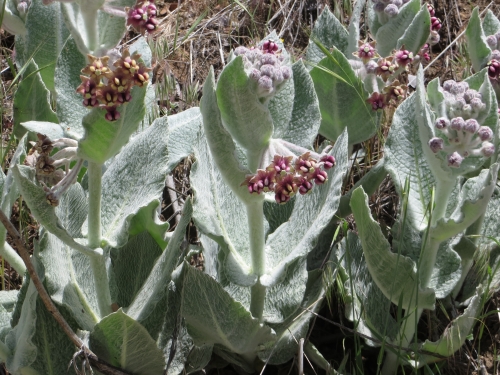
California Milkweed (Asclepias californica) is a species in the Apocynaceae (Dogbane) family. It is native to California and northern Baja California from the East Bay region southward and the foothills of the Sierra.
This flowering perennial has thick, white, woolly stems that bend or run along the ground. The plentiful, hanging flowers are rounded structures.
The flowers are dull to bright shades of lavender or pink and form an attractive contrast with the grey-to-white foliage. This plant was eaten as candy by the Kawaiisu tribes of Indigenous California; the milky sap within the leaves is said to be flavorful and chewy when cooked.
To maximize Monarch butterflies reaching their overwintering areas, plant only locally native milkweed species.
Perennial herb
3 ft Tall
3 ft Wide
Spreading
Summer Semi-deciduous

Lavender, Pink, White
Spring, Summer
Containers
Full Sun
Low, Very Low
Max 2x / month once established
Tolerates cold to 5° F
Fast, Medium, Slow
Tolerates sand and clay.
Soil PH: 6.0 - 8.0
For propagating by seed: No treatment.
Dry slopes, canyons, foothills with chaparral or woodlands; also disturbed areas, roadcuts
Chaparral, Pinyon-Juniper Woodland, Yellow Pine Forest
Milkweeds are most often used to create a butterfly garden. A wide variety of trees and shrubs can be used, including Madrone (Arbutus menziesii), Pines (Pinus spp.), Junipers (Juniperus spp.), Manzanita (Arctostaphylos spp.), Ceanothus spp., Oaks (Quercus spp.), and Coyote Brush (Baccharis spp.). Also include other butterfly-attracting herbs such as members of the Asteraceae family, other Milkweeds (Asclepias fascicularis or A. speciosa), Thistles (Cirsium spp.), Buckwheat (Eriogonum spp.), Mint (Monardella spp.), and Sage (Salvia spp.). To provide year-round attraction, mix early bloomers with late bloomers and evergreens with deciduous.
Butterflies and moths supported
2 confirmed and 1 likely