

Carried by 5 nurseries
View Availability at NurseryData provided by the participants of the Consortium of California Herbaria
View additional distribution information on the Jepson eflora
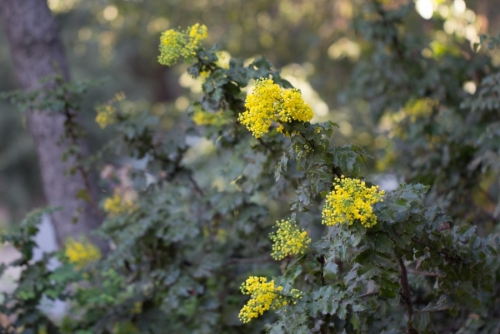
Golden Abundance Oregon Grape is a hybrid cultivar of 3 California native Berberis species that was selected for garden use. It is a dense evergreen shrub, with large compound glossy dark green leaves. It grows 5-8 feet tall by 6-8 feet wide, and can slowly spread by underground rhizomes to form plants 10 ft. wide. The plant produces large inflorescences with abundant yellow flowers in late winter to mid-spring. The flowers are followed by numerous drooping racemes of powdery purple-blue berries that are attractive to birds when they mature in late summer through fall.
Golden Abundance Oregon Grape is used as a flowering accent plant, an informal or trimmed semi-formal hedge, a screen, or a background plant in shady and woodland gardens. Since the leaves have prickly edges it can also be used as a barrier hedge to hinder animals and humans.
In coastal locations it prefers full sun to light shade. In inland locations it prefers partial shade or morning sun with afternoon shade. It can handle heat and aridity well when grown in partial shade. This plant is adaptable to many soil types from well-draining loam to clay loam. It prefers little to moderate watering when established, depending on the sun exposure and climate. It is resistant to oak root fungus and can be a drought tolerant option under mature oaks.
This 'Golden Abundance' cultivar was selected by Lee Lenz at Rancho Santa Ana Botanic Garden (present day California Botanic Garden), a chance hybrid between 3 different Berberis (classified as Mahonia at the time) species, Mahonia piperiana, M. aquifolium, and M. amplectans. Rancho Santa Ana Botanic Garden was awarded a patent on it in 1973, the first patent on a cultivated plant selection granted to a botanic garden in California.
Lenz described its distinctions from its three parents as having: a more vigorous and upright form, many lateral inflorescences along the stems, larger terminal inflorescences, and a greater overall visual abundance of flowers.
Shrub
5 - 8 ft Tall
6 - 12 ft Wide
Rounded, Upright
slow
Evergreen
Pleasant

Yellow
Spring
Bank stabilization, Groundcover, Hedge
Full Sun, Partial Shade, Deep Shade
Low, Moderate
Max 2x / month once established
Easy
Tolerates cold to 0 - 15° F
Fast, Medium, Slow
Tolerates a wide variety of soils.
Soil PH: 6.0 - 8.0
Because it spreads by rhizomes, remove any unwanted suckers to contain width. To maintain an upright form, prune wandering side branches in the dry season to avoid infection. This plant tolerates shearing and can be trained into a semi-formal hedge.
Trees - Oaks (Quercus spp.), Western Sycamore (Platanus recamosa), Douglas Fir (Pseudotsuga menziesii), Yellow Pine (Pinus ponderosa), Red Fir (Abies magnifica), and many others. Companion shrubs and herbs - Wild Ginger (Asarum caudatum), Fleabanes (Erigeron spp.), Common Yarrow (Achillea millefolia), Larkspurs (Delphiniums species), Iris species, Penstemon species, Buttercups (Ranunculus spp.), Evergreen currant (Ribes vibernifolium), Checkerbloom (Sidalcea spp.), Snowberries (Symphoricarpos spp.), Meadow Rue & varieties (Thalictrum fendleri, T. f. var. fendleri, T. f. var. polycarpum), and Canyon Sunflower (Venegasia carpesioides).
Thanks to the Theodore Payne Foundation for sharing information about this plant.