

Carried by 33 nurseries
View Availability at NurseryData provided by the participants of the Consortium of California Herbaria
View additional distribution information on the Jepson eflora
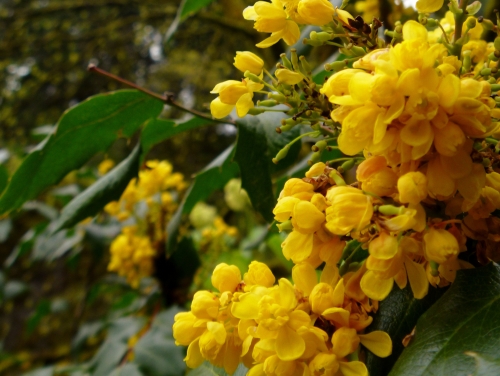
Tall Oregon grape (Berberis aquifolium) is an evergreen shrub known for its early spring blooms and colorful foliage. Clusters of bright yellow flowers appear before most other shrubs, adding a burst of color to gardens and natural landscapes. Its dark green, holly-shaped leaves stay vibrant year-round, often turning shades of purple, red, or orange in fall and winter. The plant gets its name from its dark, dusty blue berries, which resemble grapes. However, Oregon grape is not related to true grapes and belongs to the Berberidaceae family.
The berries are edible and a favorite of birds, providing a valuable food source for wildlife. This hardy shrub is well-suited for shady areas, commonly used as a hedge, foundation plant, or natural screen. Its drought tolerance and ability to stabilize soil make it useful for erosion control in restoration projects. In gardens, it works well in native landscaping and provides shelter and food for pollinators, birds, and small mammals.
There are three recognized varieties of tall Oregon grape in the wild. Berberis aquifolium var. aquifolium is the most common tall form, while var. repens is a low-growing, creeping variety often used as ground cover. Although generally safe, the roots of some Berberis species contain alkaloids that may be mildly toxic if consumed in large amounts.
With its vibrant flowers, attractive foliage, and wildlife value, tall Oregon grape is a versatile option for native gardens and natural landscapes. It adds year-round beauty while supporting local ecosystems.
Shrub
4 - 7 ft Tall
6 ft Wide
Spreading, Upright Columnar
Moderate
Evergreen
Pleasant

Yellow
Spring, Winter
Bank stabilization, Containers, Groundcover, Hedge
Full Sun, Partial Shade, Deep Shade
Moderate
Max 1x / month once established
Easy
Tolerates cold to 0° F
Medium
Tolerates many soil types.
Soil PH: 6.0 - 8.0
Because it spreads by rhizomes, remove any unwanted suckers. To maintain an upright form, prune wandering side branches in the dry season to avoid infection. It tolerates shearing and can be made into a hedge.
The species hybridizes readily and has considerable intra-specific variability. To propagate a selected variety, use cuttings from the stem or rhizome. For propagating by seed: 4-6 mos. warm then 3-4 mos. cold stratification (Heit 1971). Three mos. stratification may give satisfactory results.
Fir and pine forests and woodlands, occasionally chaparral and wetlands, up to 7, 000 ft.
Chaparral, Douglas-Fir Forest, Red Fir Forest, Yellow Pine Forest
Trees - Douglas Fir (Pseudotsuga menziesii), Yellow Pine (Pinus ponderosa), Red Fir (Abies magnifica), and many others. Companion shrubs and herbs - Wild Ginger (Asarum caudatum), Fleabanes (Erigeron spp.), Common Yarrow (Achillea millefolia), Larkspurs (Delphiniums species), Iris species, Penstemon species, Buttercups (Ranunculus spp.), Checkerbloom (Sidalcea spp.), and Canyon Sunflower (Venegasia carpesioides).
Butterflies and moths supported
0 confirmed and 5 likely
Orange Tortrix Moth
Argyrotaenia franciscana
Barberry Geometer
Coryphista meadii
Fall Webworm
Hyphantria cunea