

Carried by 3 nurseries
View Availability at NurseryData provided by the participants of the Consortium of California Herbaria
View additional distribution information on the Jepson eflora
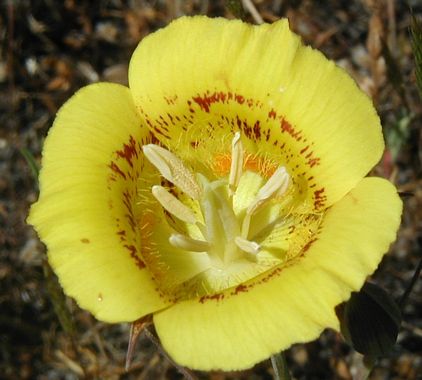
Calochortus luteus, or Yellow mariposa lily is a species of the Liliaceae endemic to California. This species is found on coastal prairie, grasslands and some open forest floors primarily in the central Coast Ranges and Sierra foothills. Like other Mariposa Lilies it grows from a bulb, with most of its growth occurring in winter, followed by spring flowering and summer dormancy. It requires good drainage and must be kept mostly dry in summer. The leaves arising directly from the bulbare strap-like and long. The flower is 3-5 centimeter across and primarily bright yellow, with sparse hair inside and often red-brown streaks or blotches. It is reported to be one of the easiest Mariposa Lilies to grow in the garden.
Perennial herb, Geophyte
2 ft Tall
6 in Wide
Upright Columnar
Summer Deciduous

Yellow, Red
Spring
Containers
Full Sun, Partial Shade
Low, Very Low
Never irrigate once established
Moderate
Tolerates cold to -5° F
Fast, Medium, Slow
Tolerates a variety of soils including sand and clay, but does not like too much organic matter.
Soil PH: 6.0 - 7.0
For propagating by seed: No treatment.
7*, 8, 9, 14*, 15*, 16*, 17*, 19*, 20*, 21*, 22*, 23*, 24*
Grasslands or openings in woodlands, typically in somewhat hilly terrain. Plant Communities: Coastal Prairie, Mixed Evergreen Woodland, Oak Woodland, Foothill Woodland, Valley Grassland
Foothill Woodland, Mixed Evergreen Forest, Valley Grassland
Plant with annuals, herbaceous perennials, or other geophytes, including wild onions (Allium spp.), Indian Milkweed (Asclepias eriocarpa), Brodiaea spp., Clarkia spp., Delphinium spp., California Poppy (Eschscholzia californica or other species), Bird's Eye Gilia (Gilia tricolor), Tidy Tips (Layia spp.), Lupines (Lupinus spp.), Baby Blue Eyes (Nemophila menziesii), Heliotrope (Phacelia spp.), Checkerbloom (Sidalcea spp.), Triteleia spp.
Butterflies and moths supported
0 confirmed and 1 likely
Orange Tortrix Moth
Argyrotaenia franciscana