

Carried by 13 nurseries
View Availability at NurseryData provided by the participants of the Consortium of California Herbaria
View additional distribution information on the Jepson eflora
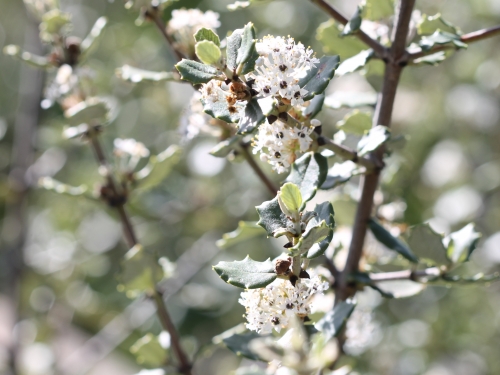
Ceanothus crassifolius is a species of flowering shrub known by the common name hoaryleaf ceanothus. This Ceanothus is found throughout the coastal mountain ranges of the southern half of California below 3,500 ft., and its range extends into Baja California. It is an erect, spreading shrub which can exceed three meters in height. The branches become long and the younger twigs are fuzzy with white or light brown hairs. The small evergreen leaves have widely-spaced teeth along the edges and the undersides are lighter in color and coated with hairs. The flower clusters are borne on short stalks less than three centimeters long and are small and rounded with tiny white flowers. They can be quite dense and can cover branches thickly, or they may be sparse. The flowers may have a yellowish or pink tint. The fruit is a horned capsule less than a centimeter wide. C. crassifolius typically occurs in California chaparral plant associations; other common flora associates are Toyon and Hollyleaf cherry.
Shrub
5 - 14 ft Tall
5 - 10 ft Wide
Upright
Slow
Evergreen
Slight

White
Winter, Spring
Bank stabilization
Full Sun, Partial Shade
Very Low
Max 2x / month once established
Tolerates cold to 12° F
Fast
Prefers granular, well drained soil such as decomposed granite.
Soil PH: 6.0 - 8.0
For propagating by seed: Hot water and 2-3 mos. stratification.
7*, 8, 9, 14, 15, 16, 17, 18*, 19*, 20*, 21*, 22*, 23*, 24*
Dry inland ridges, slopes and fans as part of southern chaparral
Chaparral, Pinyon-Juniper Woodland, Yellow Pine Forest
Bush Poppy (Dendromecon rigida), Thickleaf Yerba Santa (Eriodictyon crassifolium), Toyon (Heteromeles arbutifolia), Scrub Oak (Quercus berberidifolia), and Hollyleaf cherry (Prunus ilicifolia)
Butterflies and moths supported
2 confirmed and 80 likely