

Carried by 6 nurseries
View Availability at NurseryData provided by the participants of the Consortium of California Herbaria
View additional distribution information on the Jepson eflora
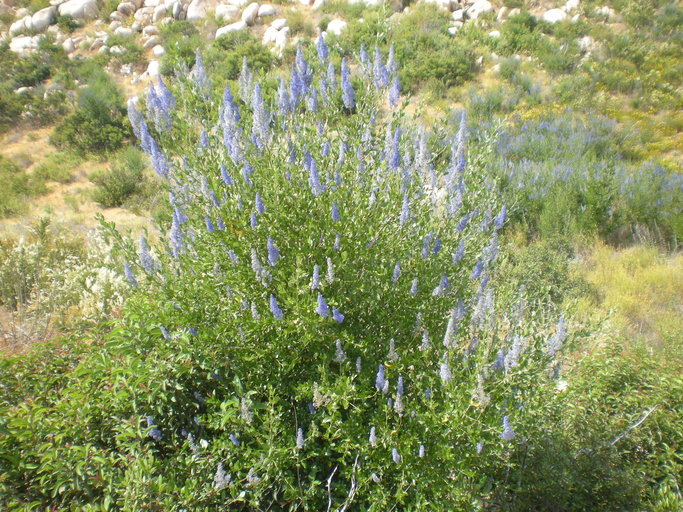
Ceanothus cyaneus is a rare species of flowering shrub known by the common names San Diego Ceanothus and Lakeside Ceanothus. This Ceanothus is found in the mountains of San Diego County, California, and its range probably extends just into Baja California. Most of the remaining natural specimens are in a small area in the hills around Lakeside and Ramona in San Diego County. This is a tall, erect shrub which may approach 5 meters in height. Its spreading branches are gray-green, with the younger twigs a light greenish-brown. The evergreen leaves may be serrated and toothed with hairy knobs, or they may be smooth along the edges. The underside is a lighter green than the upper surface. The flower cluster may exceed 15 centimeters in length, bearing many bunches of flowers along the length of a greenish stalk. The long flowers exhibit protruding yellow anthers. The capsule fruits are about 4 millimeters long.
Ceanothus cyaneus can be tricky to grow in landscaping applications. After the first year, direct summer water will usually kill it, but it will often also die if it can't get it's roots to moisture over the summer. It's best to plant on dry rocky slopes near a damper area, such as a seasonal creek, or near an irrigated area, or even 5-10 feet from a bubbler. It does best if surrounded by rocks or other plants that can shade its roots from the sun. If happy, it produces profuse displays of flower ranging from bright blue to powder blue to dark purple in color. It does best on north facing slopes, but can also handle east or west facing slopes if there is nearby water.
Shrub
8 - 16 ft Tall
12 ft Wide
Rounded
Fast
Evergreen
Pleasant

Blue, Purple
Winter, Spring
Bank stabilization
Full Sun, Partial Shade
Low, Very Low
Never irrigate once established
Moderate
Tolerates cold to 25° F
Fast
Tolerates clay soil but does best in well drained decomposed granite.
Soil PH: 6.0 - 8.0
Pruning is recommended to control its tendency toward straggly growth. Prune to desired shape in dry season to prevent infection.
For propagating by seed: Hot water; then 3 mos. stratification may improve germination.
Dry rocky slopes, foothills and inland valleys among chaparral primarily in the Peninsular Range of San Diego County. At higher elevations, also found in conjunction with pine forest
Chaparral, Closed-cone Pine Forest
Use with other chaparral plants of southern California such as Manzanitas (Arctostahpylos species), Toyon (Heteromeles arbutifolia), Lemonadeberry (Rhus integrifolia), California Encelia (Encelia californica), Sagebrush (Artemisia californica), California Buckwheat (Eriogonum fasciculatum), Chamise (Adenostem fasciculatum), Bush Rue (Cneoridium dumosum), Tree Poppy (Dendromecon rigida), Thickleaf Yerba Santa (Eriodictyon crassifolium), Flannel Bush (Fremontodendron spp.), Mallow (Malacothamnus spp.), Scrub Oak (Quercus berberidifolia), Sages (Salvia spp.), Dudleya species, cactus species and annuals.
Butterflies and moths supported
0 confirmed and 63 likely
Western Avocado Leafroller Moth
Amorbia cuneana
Common Gray
Anavitrinella pampinaria