

Carried by 49 nurseries
View Availability at NurseryData provided by the participants of the Consortium of California Herbaria
View additional distribution information on the Jepson eflora
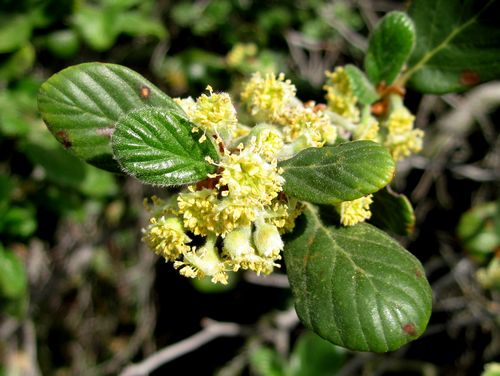
Mountain Mahogany (Cercocarpus betuloides) is a distinctive-looking shrub that provides visual interest in the landscape. It is known for its long, fuzzy seeds that resemble curled feathers and shine in the sun. "Cercocarpus" means fruit with a tail. The evergreen, birch-like leaves have edges that are smooth at the bottom and toothed at the top. Its small yellow flowers attract hummingbirds and butterflies. Mountain Mahogany is named for its dark bark color, but this plant is actually a member of the Rose family.
This shrub has a tall, upright habit and a fast growth rate. It is often used in narrow areas and as a hedge or privacy screen. It responds well to light or heavy pruning, which may be necessary when planted in small spaces. It can also be cut down to the ground for new growth. It's a low-water plant and adapts to a variety of soil types. Mountain Mahogany is notable for its extensive root system and is often used for restoration and bank stabilization.
Shrub
8 - 20 ft Tall
10 - 12 ft Wide
Rounded, Upright Columnar
Fast, Moderate
Evergreen

Cream, White
Winter, Spring
Hedge
Partial Shade, Full Sun
Very Low
Max 1x / month once established
Moderate
Tolerates cold to 20° F
Fast, Medium, Slow
adaptable.
Tolerates serpentine soil..
Soil PH: 5.0 - 8.0
Responds well to pruning/occasional hard pruning. Can be pruned to to fit well into narrow areas.
For propagating by seed: No treatment; 1-1.5 mos. stratification may improve germination (Heit 1971; Hildreth and Johnson 1976).
Slopes, often near runoffs or slightly damper areas, as part of chaparral or woodland with oaks or pines
Chaparral, Northern Oak Woodland
Good with Oak species, Toyon (Heteromeles arbutifolia), Coffeeberry species, Manzanita species, Ceanothus species, sages, and most other chaparral species
Butterflies and moths supported
10 confirmed and 21 likely
Elegant Sheepmoth
Hemileuca eglanterina
Ceanothus Silkmoth
Hyalophora euryalus
Bornstein, C., Fross, D., O'Brien, B. (2005). California Native Plants for the Garden. Cachuma Press.