

Carried by 7 nurseries
View Availability at NurseryData provided by the participants of the Consortium of California Herbaria
View additional distribution information on the Jepson eflora
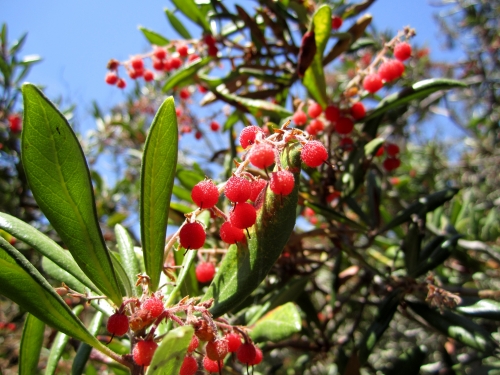
Comarostaphylis diversifolia is a rare shrub in the heath family known by the common name Summer Holly. It is slow growing in an upright form up to a height of 20 feet or more, with striking white flowers in the spring, an incredible summer display of holly-like red berries , and attractive gray bark. It is native to southern California and northern Baja California, where it grows in coastal chaparral habitat, usually on well drained slopes. Its bark is gray and shreddy and the tough, evergreen leaves are oval in shape and sometimes toothed. The flower cluster is a raceme of urn-shaped flowers very similar to those of the related shrubs, the manzanitas. The fruit is a bright red, juicy drupe with a bumpy skin. There are two subspecies. C. d. ssp. diversifolia - native to the coastal hills of southern California and Baja California, C. d. ssp. planifolia - native to the Channel Islands of California and the Transverse Ranges north of Los Angeles. Subspecies diversifolia tends to grow with Mission Manzanita, Scrub Oak and Toyon.
In nature, Summer Holly is most often found on shady dry slopes, near occasional creeks or runoffs. It grows slowly until it breaks through the lower canopy, and gets its leaves in the sun. In landscapes it does best in dry part shade, near irrigated spots or other slightly damp areas. It prefers heavier, richer soils that retain the little moisture it gets a little longer. Best to plant Summer Holly in the fall, so it can get established by summer. This plant is among the least tolerant to direct water in the summer. After the first year, direct water in the summer will usually kill it.
Shrub
10 - 20 ft Tall
3 - 15 ft Wide
Rounded
Slow
Evergreen
None

Cream, Pink, White
Spring, Summer
Bank stabilization, Deer resistant
Partial Shade
Low, Very Low
Max 1x / month once established
Moderate
Tolerates cold to 30° F
Fast, Medium
This subspecies prefers eroded sandstone soils of marine deposits that are typical of coastal San Diego County. The preceding is not accurate. This plant is not a subspecies, and it is widespread in Southern California, not just in San Diego County.
Soil PH: 6.0 - 8.0
For propagating by seed: Slightly green or Fresh seeds need no treatment. Stored seeds 3 mos. stratification.
Dry shady, often north facing slopes of dense southern maritime chaparral on the coastal side of the Peninsular Range
Chaparral
Scrub Oak (Quercus berberidifolia), Nuttall's Scrub Oak (Quercus dumosa), Woollyleaf Ceanothus (Ceanothus tomentosus), Toyon (Heteromeles arbutifolia), Mission Manzanita (Xylococcus bicolor), Bush Rue (Cneoridium dumosum), Santa Barbara Honeysuckle (Lonicera subspicata var. denudata), California Sagebrush (Artemisia californica), Coyote Bush (Baccharis pilularis), Diplacus puniceus, Rhus integrifolia.
Butterflies and moths supported
0 confirmed and 3 likely