

Carried by 34 nurseries
View Availability at NurseryData provided by the participants of the Consortium of California Herbaria
View additional distribution information on the Jepson eflora
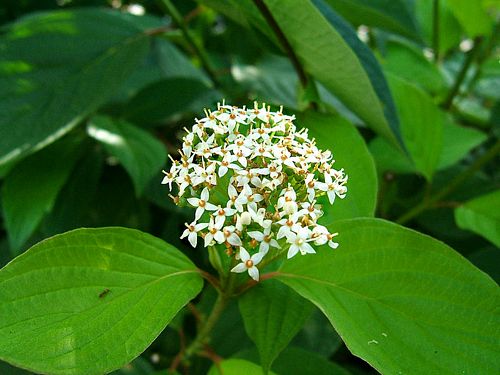
The Red Osier Dogwood (Cornus sericea, syn. C. stolonifera, Swida sericea) is a species of dogwood native throughout northern and western North America from Alaska east to Newfoundland, south to Durango and Nuevo Len in the west, and Illinois and Virginia in the east. Other names include Redtwig Dogwood, Red-rood, American Dogwood, and (subsp. occidentalis) Western Dogwood. In the wild, it commonly grows in areas of damp soil, such as wetlands. It is a medium to tall deciduous shrub, growing 1.5-4 meter tall and 3-5 meter wide, spreading readily by underground stolons to form dense thickets. The branches and twigs are dark red, although wild plants may lack this coloration in shaded areas. The leaves are opposite, 5-12 centimeter long and 2.5-6 centimeter broad, with an ovate to oblong shape and an entire margin; they are dark green above and waxy pale below; fall color is commonly bright red to purple. The flowers are small (5-10 millimeter diameter), dull white in color, in clusters 3-6 centimeter diameter. The fruit is a globose white berry 5-9 millimeter diameter.
Shrub, Tree
4 - 13 ft Tall
9 - 15 ft Wide
Spreading
Fast
Winter Deciduous
Slight

White, Purple, Red
Summer
Hedge, Water features or wet habitats
Deep Shade, Partial Shade, Full Sun
High
Max 1x / week once established
Easy
Tolerates cold to 0 - 10° F
Medium, Slow, Standing
Tolerates a variety of soils but does best in moist, rich loamy soil.
Soil PH: 5 - 7
1, 2, 3, 4*, 5*, 6*, 7*, 8*, 9*, 10, 14*, 15*, 16*, 17*, 18*, 19*, 20*, 21*, 22*, 23*, 24
Moist places
Wetland-Riparian
Maples (Acer spp.), Ash (Fraxinus spp.), Walnut (Juglans spp.), Western Sycamore (Platanus racemosa), Cottonwood (Populus spp.), Willow (Salix spp.), Spicebush (Calycanthus occidentalis), Wild Honeysuckle (Lonicera spp.), Wild Azalea (Rhododendron spp.), Wild Currant (Ribes spp.), Wild Rose (Rosa spp.), and Wild Grape (Vitis spp.)
Butterflies and moths supported
13 confirmed and 29 likely
Forbes' Acleris Moth
Acleris forbesana
Triton Dagger Moth
Acronicta grisea
Polyphemus moth
Antheraea polyphemus
Salt-and-Pepper Geometer
Biston betularia