

Carried by 31 nurseries
View Availability at NurseryData provided by the participants of the Consortium of California Herbaria
View additional distribution information on the Jepson eflora
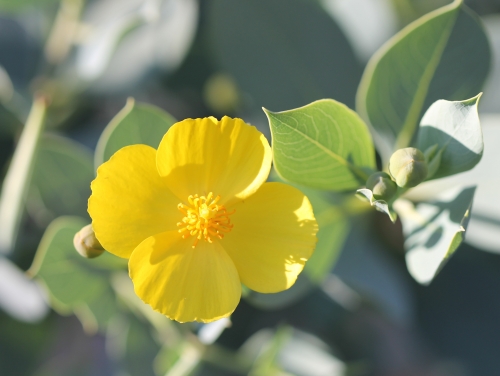
Channel Islands tree poppy (Dendromecon harfordii) is a flowering shrub or small tree and one of the most popular native plants with gardeners. It blooms with an abundance of bright yellow flowers that contrast with sparse blue-gray oval leaves on thin, branching stems. The flowering season is winter to spring but throughout most of the year, it can be covered in showy flowers.
Channel Island Tree Poppy is spectacularly beautiful, easy to grow, and very fast growing. It can grow to 6 feet in two years. It likes full sun and well-draining soils, though it also does well in dry part-shade. It likes gentle slopes and flats. It is very tolerant of summer water for its first two years, but when mature, it's best to reduce it to 1x / month or eliminate supplemental water completely, especially if the plant is in partial shade.
Shrub
4 - 20 ft Tall
8 ft Wide
Fountain
Fast
Evergreen
None

Yellow
Summer, Spring, Fall
Hedge
Full Sun, Partial Shade
Very Low, Low
Max 1x / month once established
Moderate
Tolerates cold to 5° F
Fast, Medium, Slow
Tolerates sandy or clay soils.
Soil PH: 5.0 - 8.0
For propagating by seed: Fire treatment or 1 to 1.5 months stratification (Hildreth and Tohnson 1976). Stratification for 3 months with a diurnal fluctuation from 46° to 70°F may improve germination. More easily propagated from stem cuttings in winter with intermittent mist and bottom heat.
7, 8*, 9*, 14*, 15*, 16*, 17*, 18, 19*, 20*, 21*, 22*, 23*, 24*
Chaparral, coastal sage scrub, coastal bluff scrub, and foothill woodland slopes, canyons and flats on the Channel Islands, where the climate is very strongly marine-influenced.
Chaparral, Coastal Sage Scrub, Foothill Woodland
Island companion plants include Santa Cruz Island Ironwood (Lyonothamnus floribundus ssp. asplenifolius), Island Live Oak (Quercus tometella), Catalina Cherry (Prunus ilicifolia ssp. lyonii), Island Bristleweed (Hazardia detonsa), Redflower Buckwheat (Eriogonum grande var. rubescens), Island Snapdragon (Gambelia speciosa), and Giant Coreopsis (Leptosyne gigantea). Other chaparral and sage scrub companions include California Encelia (Encelia californica), California Sagebrush (Artemisia californica), Bladderpod (Peritoma arborea), and Ceanothus spp.
Butterflies and moths supported
0 confirmed and 1 likely