

Carried by 18 nurseries
View Availability at NurseryData provided by the participants of the Consortium of California Herbaria
View additional distribution information on the Jepson eflora
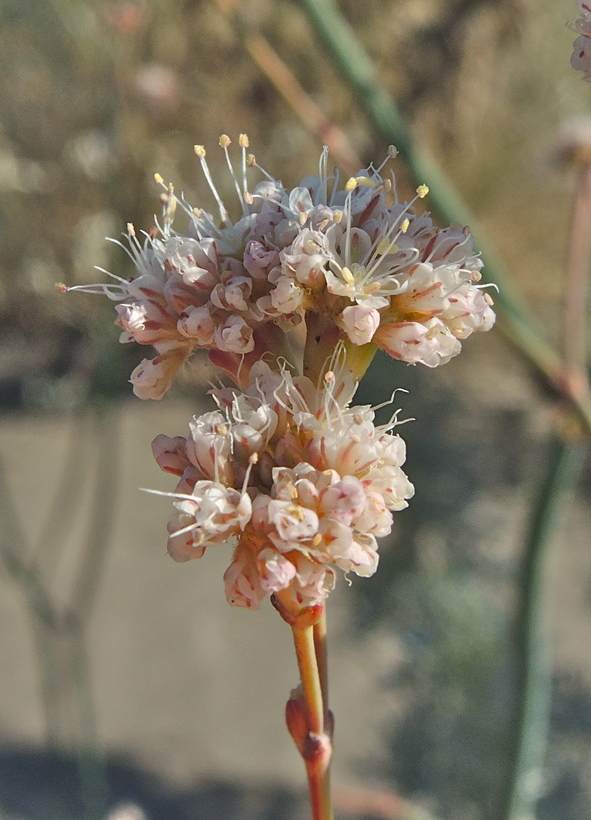
Nude buckwheat (Eriogonum nudum) is a perennial shrub in the wild buckwheat family that features a striking, upright form. It has a basal rosette of flat green leaves from which tall, bare stems rise, reaching up to six feet. At the top of these stems, rounded clusters of white, pale pink, or yellow flowers bloom, adding delicate color to the landscape.
This adaptable plant has one of the widest ecological distributions of all buckwheats. It thrives in environments ranging from wet coastal areas to the cold, dry elevations of the Sierra Nevada. While the species is generally common, certain varieties are rare.
Nude buckwheat is easy to grow and looks especially beautiful when planted in groups for a massed effect. The nectar-rich flowers attract bees, butterflies, and other pollinators, while its seeds provide food for birds. Additionally, the plant serves as a host for caterpillars, supporting native ecosystems.
Shrub
6 - 12 in Tall
4 - 7 in Wide
Mounding
Moderate
Summer Semi-deciduous

Yellow, Pink, White
Summer, Spring
Deer resistant
Full Sun
Very Low, Low
Max 1x / month once established
Moderate
Tolerates cold to -15 - -10° F
Fast, Medium, Slow
Adaptable.
Harvest seeds from bracts in early fall. If directly seeding in the fall, no treatment is required, otherwise cold/moist stratification for 90 days will significantly improve germination. Carefully control weeds during the first year of establishment.
Exposed, sunny sites, including dry open places, rocky outcrops, along trails and roadsides.
Chaparral, Coastal Strand, Foothill Woodland, Joshua Tree Woodland, Pinyon-Juniper Woodland, Southern Oak Woodland, Valley Grassland, Yellow Pine Forest
California Buckwheat (Eriogonum fasciculatum), Black Sage (Salvia mellifera), Chamise (Adenostoma fasciculatum), Eastern Mojave Buckwheat (Eriogonum fasciculatum var foliolosum), White Sage (Salvia apiana), Interior California Buckwheat (Eriogonum fasciculatum var polifolium); Chaparral Yucca (Hesperoyucca whipplei)
Butterflies and moths supported
9 confirmed and 39 likely
Mormon Metalmark
Apodemia mormo
Bramble Hairstreak
Callophrys dumetorum
Square-spotted Blue
Euphilotes battoides
Dotted Blue
Euphilotes enoptes