

Carried by 79 nurseries
View Availability at NurseryData provided by the participants of the Consortium of California Herbaria
View additional distribution information on the Jepson eflora
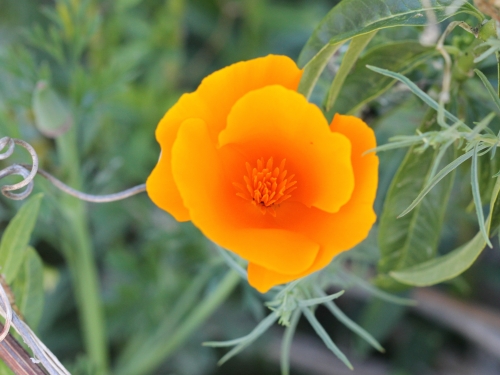
The California poppy (Eschscholzia californica) is the state flower of California. Every garden can find a place for this easy, cheerful annual. It self-seeds freely and will give your whole neighborhood poppies, but is not particularly invasive.
The plant grows in full sun but will tolerate part shade. It reaches one to two foot tall and can be perennial in milder areas. The feathery foliage is blue-green The flowers range from yellow to bright orange, appearing from February to September, though primarily in spring. The petals may remain closed in cloudy weather. The fruit is a slender capsule which splits to release numerous small black or dark brown seeds. The seeds are ready to take when the pods become dry and brown. Birds, butterflies, bees and other pollinators are attracted to this plant. Rabbits may browse the leaves but it is deer resistant.
It is best introduced into the garden from seed sown in fall at the start of the rainy season. Do not cover the seeds with soil or mulch. California poppies like fast draining soil and plenty of sunshine but are very hardy and will also thrive in poor soil conditions, such as clay. If planting from seedlings, be careful with the long sensitive roots and water occasionally until established.
Annual herb, Perennial herb
2 - 24 in Tall
1 - 2 ft Wide
Upright, Mounding, Rounded
Fast, Moderate
Summer Deciduous
Slight

Orange, Yellow
Summer, Spring, Fall, Winter
Containers, Deer resistant
Full Sun
Very Low
Max 2x / month once established
Easy
Tolerates cold to 10 - 20° F
Fast, Medium, Slow
Prefers sandy, infertile, well-drained soils.
Soil PH: 5 - 8
Best to cut down to the ground after the plant goes summer deciduous. Sometimes plants will last through the summer and come back when the rainy season begins, especially in milder climates.
Easily grown from seed, and readily reseeds. Can be invasive. For propagating by seed: No treatment.Seeds can be hand-collected from the seed pods the plant produces after the flower's petals fall off. The seeds are ready to take when the pods become dry and brown. This plant propagates itself by the design of the seed pods which burst open with a impressive amount of force. To plant: Simply take the seeds and throw them in the desired area and allow the rains to water them. Do not cover with soil or mulch. Watering is helpful until plants are established.
1, 2, 3, 4, 5, 6*, 7*, 8*, 9*, 10*, 11*, 12*, 13, 14*, 15*, 16*, 17*, 18*, 19*, 20*, 21*, 22*, 23*, 24*
open, grassy places.
Northern Coastal Scrub, Yellow Pine Forest, Red Fir Forest, Lodgepole Forest, Foothill Woodland, Chaparral, Coastal Prairie, Valley Grassland
Great companion plants include these families Lupinus spp., Phacelia spp., Clarkia spp., Collinsia spp., Abronia spp., Buckwheat spp.. Frequent companions also include: California Fuchsia (Epilobium canum), White Sage (Salvia apiana), California Buckwheat (Eriogonum fasciculatum).
Butterflies and moths supported
5 confirmed and 2 likely
Mormon Metalmark
Apodemia mormo
Dotted Blue
Euphilotes enoptes
Acmon Blue
Icaricia acmon
Veined Blue
Icaricia neurona