

Carried by 5 nurseries
View Availability at NurseryData provided by the participants of the Consortium of California Herbaria
View additional distribution information on the Jepson eflora
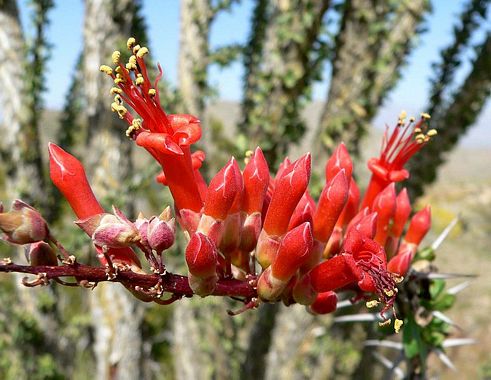
Ocotillo is a curious-looking and unique desert plant of the southwestern United States and northern Mexico. Common names include Ocotillo, Coachwhip, Jacob's staff, and Vine Cactus, although it is not a true cactus. For much of the year, the plant appears to be an arrangement of large spiny dead sticks, although closer examination reveals that the stems are partly green. With rainfall the plant quickly becomes lush with small 2-4 centimeter ovate leaves, which may remain for weeks or even months. The stems may reach a diameter of 5 centimeters at the base, and the plant may grow to a height of 10 meters, but growth is very slow. Large specimens in the wild may be 200 years old. The plant branches very heavily at its base, but above that the branches are pole-like and only infrequently divide further, and specimens in cultivation may not exhibit any secondary branches. The plant produces two types of leaves. The first leaves on new growth produce a petiole (leaf stalk) which hardens into a sharp spine after the leaf drops off. Subsequent leaves sprout from the base of the spine. The bright red flowers appear in spring and summer, occurring as a group of small tube shapes at the tip of the stem. They are pollinated by hummingbirds or carpenter bees.
Shrub, Succulent
10 - 33 ft Tall
15 ft Wide
Upright, Fountain, Upright Columnar
Very Slow, Fast
None

Red
Summer, Spring
Deer resistant
Full Sun
Very Low
Max 1x / month once established
Moderate
Tolerates cold to 20° F
Fast
Prefers rocky, sandy or decomposed granite soil.
Soil PH: 7.0 - 9.0
It can be propagated from cuttings, but results are variable. For propagating by seed: No treatment.
Native to the Colorado Desert (and slightly extending into the Mojave Desert), it is found in very arid slopes, canyons, washes and alluvial fans in fast draining sandy, gravelly soil, often among boulders but also in pure sand
Creosote Bush Scrub, Desert-Holly Scrub, Joshua Tree Woodland
Creosote Bush (Larrea tridentata), Brittlebush (Encelia farinosa), Jojoba (Simmondsia chinensis), Blue Paloverde, White Bursage (Ambrosia dumosa), Chuparosa (Justicia californica), Barrel Cactus, Desert Lavender (Condea emoryi), Indigo Bush, Apricot Mallow (Sphaeralcea ambigua var. rugosa), Opuntia spp., numerous annual wildflowers
To learn more, visit the Jepson Herbarium's YouTube channel and watch a short video about this species: https://www.youtube.com/watch?v=4MV_D78A0jw&t=2s