

Carried by 29 nurseries
View Availability at NurseryData provided by the participants of the Consortium of California Herbaria
View additional distribution information on the Jepson eflora
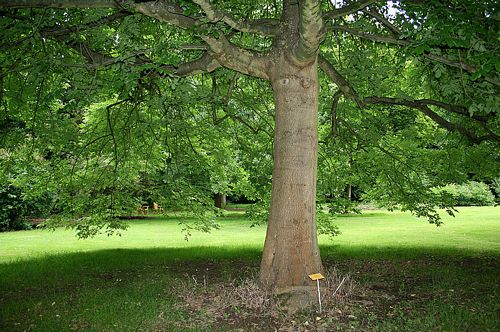
Fraxinus latifolia (Oregon ash) is a member of the Oleaceae (Olive) family native to western North America on the west side of the Cascade Range from southwestern British Columbia south through western Washington and western Oregon to central California. It can grow to 25 meters in height, with a trunk diameter of 30-80 centimeter, and it is typically larger in the northern part of its range. Trees can live to 250 years; young trees are fast growing, slowing down in maturity. It is usually found in riparian corridors within forest, woodland, chaparral, or grassland. The compound leaves are pinnate, 12-33 centimeter long, with 5-9 leaflets, each leaflet ovate, 6-12 centimeter long and 3-4 centimeter broad, and often show signs of disease and brown rot, even on otherwise healthy plants. The inconspicuous flowers are dioecious, meaning that male and female parts are contained in separate flowers. The fruit is a samara, 3-5 centimeter long including the wing, and not usually produced until the tree reaches 20-30 years of age. It is also a vigorous stump-sprouter.
Tree
35 - 82 ft Tall
30 ft Wide
Upright
Fast, Moderate
Winter Deciduous

Green
Spring
Full Sun, Partial Shade
Moderate
Easy
Slow
Typically found in poorly drained, moist bottom land with deep soil rich in humus.
For propagating by seed: 3 mos. stratification.
1, 2, 3, 4*, 5*, 6*, 7*, 8*, 9*, 14*, 15*, 16*, 17, 18, 19, 20, 21, 22, 23, 24
Slopes and streambanks sea level to over 5, 000 ft.
Chaparral, Foothill Woodland, Valley Grassland, Yellow Pine Forest, Wetland-Riparian
Use with other wetland-riparian trees and shrubs such as Maples (Acer spp.), Alders (Alnus spp.), Dogwood (Cornus spp.), California Walnut (Juglans californica or hindsii), Sycamore (Platanus racemosa), Cottonwood (Populus spp.), Currant/Gooseberry (Ribes spp.), wild rose (Rosa spp.), and wild grape (Vitis californica or girdiana). Also works well with various wetland grasses and grass-like plants such as Sedges (Carex spp.), Spikerush (Eleocharis spp.), Rushes (Juncus spp.), and Alkali Sacaton (Sporobolus airoides)
Butterflies and moths supported
0 confirmed and 41 likely
Yellow-Haired Dagger Moth
Acronicta impleta
Fall Cankerworm Moth
Alsophila pometaria
Miranda Underwing
Amphipyra pyramidoides
Common Gray
Anavitrinella pampinaria