

Carried by 14 nurseries
View Availability at NurseryData provided by the participants of the Consortium of California Herbaria
View additional distribution information on the Jepson eflora
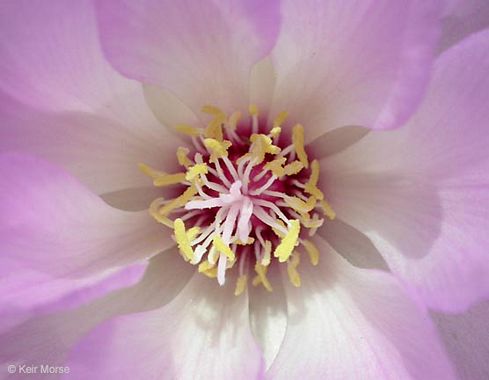
Bitterroot (Lewisia rediviva Pursh) is a small, low plant in the Montiaceae (Purslane) family that is found in scattered locations in mountain areas of California up to 9,700 ft. It has a showy pink to white flower and is the state flower of Montana. The Lewisia genus is named after Meriwether Lewis. It is a low-growing perennial plant with a fleshy taproot and a simple or branched base. The The plant goes dormant in summer but will emerge from the taproot with winter rain. flower stems are leafless, 1-3 centimeter tall, bearing at the tip a whorl of 5-6 linear leafs which are 5-10 millimeter long. A single, relatively large flower appears on each stem with 6-9 oval shaped sepals. They range in color from whitish to deep pink or rose during May and June. The petals (usually about 15) are oblong in shape and are 18-35 millimeter long in length. Also see Lewisia cotyledon, a closely related species.
Perennial herb, Succulent
1 ft Tall
1 ft Wide
Summer Deciduous

Pink, White
Spring
Containers
Full Sun, Partial Shade
Very Low
Never irrigate once established
Tolerates cold to -5° F
Fast, Medium, Slow
Typically requires fast draining rocky or gravelly soil.
Soil PH: 5.0 - 7.0
Rocky, sandy ground, talus, clay, granite, shale, open areas
Foothill Woodland, Mixed Evergreen Forest, Pinyon-Juniper Woodland, Sagebrush Scrub, Yellow Pine Forest
Use with other herbaceous species of the mountains, woodlands and forests such as onion (Allium spp.), Brodiaea spp., Sulphur Buckwheat (Eriogonum umbellatum), California Poppy (Eschscholzia californica), Blue Flax (Linum lewisii), Mosquito Bill (Primula hendersonii), California Buttercup (Ranunculus californica), and Blue Eyed Grass (Sisyrinchium bellum)