

Carried by 27 nurseries
View Availability at NurseryData provided by the participants of the Consortium of California Herbaria
View additional distribution information on the Jepson eflora
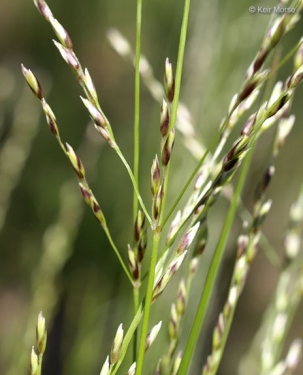
Melica imperfecta is a species in the Poaceae (Grass) family known by the common names California Melic, Small Flower Melic and Little California Melic. It is native to the southwestern United States and Baja California, where it grows in chaparral, woodlands, and other dry areas. In California it is found primarily in the central and southern portions of the state, along the coast, in the coastal mountain ranges, and in the foothills of the Sierras. It is a perennial bunchgrass growing up to 1.2 meters in maximum height. The flower cluster is a narrow or spreading series of attractive spikelets which are green in color with areas of purple. With supplemental water it will remain evergreen; otherwise it is summer dormant. It greens up early with fall/winter rain.
Grass
3 - 4 ft Tall
1 ft Wide
Upright, Fountain
Moderate
Summer Semi-deciduous, Evergreen
None

Yellow, Brown
Spring, Winter
Deer resistant, Lawn alternative
Full Sun, Partial Shade
Moderate, Very Low
Max 1x / month once established
Easy
Tolerates cold to 0° F
Fast, Medium
Tolerates a variety of soils.
Soil PH: 5.0 - 8.0
If allowed to go dormant in summer, the plant can be cut back to a few inches
For propagating by seed: No treatment. Best sown in fall.
7, 11, 14*, 15*, 16*, 17*, 18*, 19*, 20*, 21*, 22*, 23*, 24*
Dry rocky and/or sandy hillsides, canyons and mesas of central and southern California, extending into the desert edge. Found with Chaparral, coastal sage scrub, and various woodland types
Chaparral, Coastal Sage Scrub, Creosote Bush Scrub, Foothill Woodland, Pinyon-Juniper Woodland, Southern Oak Woodland
Use as an understory with Oaks (Quercus spp.) or other trees. Also useful in a meadow-like garden or rock garden with other native grasses, annual wildflowers, herbaceous perennials such as California Poppy (Eschscholzia californica), succulents such as Dudleya spp., and various cactus species.
Butterflies and moths supported
0 confirmed and 1 likely
Rural Skipper
Ochlodes agricola