

Carried by 14 nurseries
View Availability at NurseryData provided by the participants of the Consortium of California Herbaria
View additional distribution information on the Jepson eflora
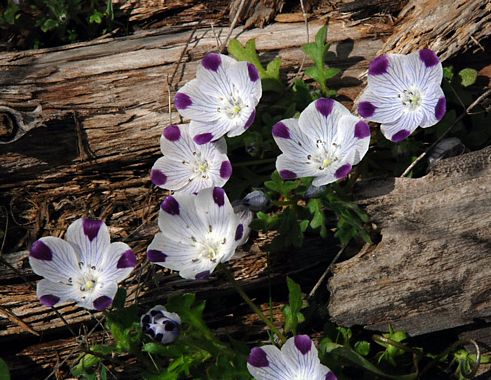
Named for the five purple spots that adorn each flower petal tip, Fivespot (Nemophila maculata) is a cute and cheerful annual that's native to California's Sierra foothills. Fivespot is a member of the Borage family. It is related to Baby Blue Eyes (Nemophila menziesii), another popular native annual. But it is not related to Desert Fivespot (Eremalche rotundifolia).
Fivespot's appealing white and purple flowers bloom in early spring and attract bees, butterflies, and other insects. Fivespot is a low, compact plant, making it a good choice for containers and small beds. It likes sun or partial shade and does best in loose, nutrient-rich garden soil. Since it is native to cooler regions of California, it tolerates cold temperatures but needs afternoon shade and supplemental moisture in hot, dry climates. Fivespot seeds are often included in wildflower seed mixes and the plant will self-sow in the garden.
Annual herb
6 - 12 in Tall
1 ft Wide
Spreading
Fast

White, Blue, Purple
Spring, Winter
Full Sun, Partial Shade, Deep Shade
Low
Max 2x / month once established
Moderate
Tolerates cold to 0° F
Fast, Medium
Prefers sand but tolerates garden soil.
Soil PH: 6.0 - 8.5
For propagating by seed: No treatment may give satisfactory results. For more uniform germination, stratify for 2 mos. or germinate at cool temperatures (less than 70°F) and in darkness for first 3 days (Cruden 1974).
1, 2, 3, 4*, 5*, 6*, 7, 8, 9, 14, 15*, 16*, 17*, 18, 19*, 20*, 21*, 22*, 23*, 24
Meadows, roadbanks, grasslands, and openings in forest or woodlans
Foothill Woodland, Red Fir Forest, Valley Grassland, Yellow Pine Forest
This species works very well with other annual or herbaceous perennial wildflowers in a meadow garden, including the closely related Baby Blue Eyes (Nemophila menziesii), California Poppy (Eschscholzia californica), Clarkia spp., Chinese Houses (Collinsia heterophylla), Gilia spp., Lupinus spp., Penstemon spp., Phacelia spp., and many others. Also works well with geophytes such as Brodiaea spp., Mariposa Lily (Calochortus spp.) and Dichelostemma spp., as well as various catcus and succulent species such as Dudleya spp.
Butterflies and moths supported
0 confirmed and 4 likely
Alfalfa Looper Moth
Autographa californica
Funereal Duskywing
Erynnis funeralis
Calscape, Bornstein, C., Fross, D., O'Brien, B. (2005). California Native Plants for the Garden. Cachuma Press Nemophila Maculata - Plant Finder. Www.missouribotanicalgarden.org, www.missouribotanicalgarden.org/PlantFinder/PlantFinderDetails.aspx?taxonid=281060&isprofile=0&. Accessed 12 Feb. 2024.